Deep Work in an Open Office: Applying Cal Newport's Four Rules in Practice
Reading time: 9 min, last updated: April 2026
Key takeaways:
- Of Cal Newport's four Deep Work rules, only the first is about focused work itself. The other three (Embrace Boredom, Quit Social Media, Drain the Shallows) address attention training, digital tools, and shallow work overhead. Three-quarters of the book is therefore about the environment around the work, not the work itself.
- Newport's Rhythmic scheduling philosophy, which he recommends as the default for most people, fails in most organizations because hierarchical demands override individual focus time. What works is closer to his Journalistic philosophy combined with a spatial split: deep work moves to home office days, shallow work stays in the office.
- The concrete adaptations that replaced Newport's rules in my own work: all notifications disabled in Outlook, Teams, and Slack with exceptions only for management, a 15 to 20 minute daily social media budget enforced by a time blocker, shallow work batched into two fixed blocks per day, and a silent commute without a podcast that serves as both shutdown ritual and attention training.
Deep Work has become a label. People use the term for any kind of focused work: blocking time in a calendar, putting on headphones, trying to think before the next meeting arrives. When you open Cal Newport's 2016 book of the same name, the definition is narrower. Deep Work means work performed in a state of distraction-free concentration that pushes cognitive capabilities to their limit.
The book proposes four rules to support this kind of work. Only the first is directly about the work itself. The other three address the environment around it: attention, digital tools, and shallow work overhead. For anyone with calendar control and a private office, the rules are demanding but doable. For most knowledge workers, that is not the environment they work in.
I have worked in open-plan offices for my entire career so far, across startups and large corporations. That is not unusual. Single offices for individual contributors have largely disappeared from corporate real estate over the last two decades, and open-plan seating with shared desks has become the default for most knowledge work roles. When I first read Deep Work a few years after it came out, I was already sitting at a desk with ten colleagues in earshot, a manager expecting quick replies, and a calendar I did not fully control.
This article is my attempt, some years later, to go back through Newport's four rules and show which parts of the framework hold up in that environment, which parts broke when I tried to apply them, and what I have ended up doing instead. It is not a rebuttal of the book. I still think Deep Work is one of the most useful productivity books of the last decade, and parts of it were ahead of their time. Newport was one of the first mainstream voices to argue for quitting social media, at a point when the recommendation was treated as eccentric rather than sensible. A decade later, entire countries are considering age restrictions on the same platforms. His diagnosis was right.
What this article questions is not the diagnosis but the prescriptions. Newport wrote the book from a single office at Georgetown University, where he controls his own calendar. Reading it from an open-plan corporate floor changes which parts of the framework apply. The rest is a working-through of each rule in order: what it proposes, where it breaks, and what replaced it.
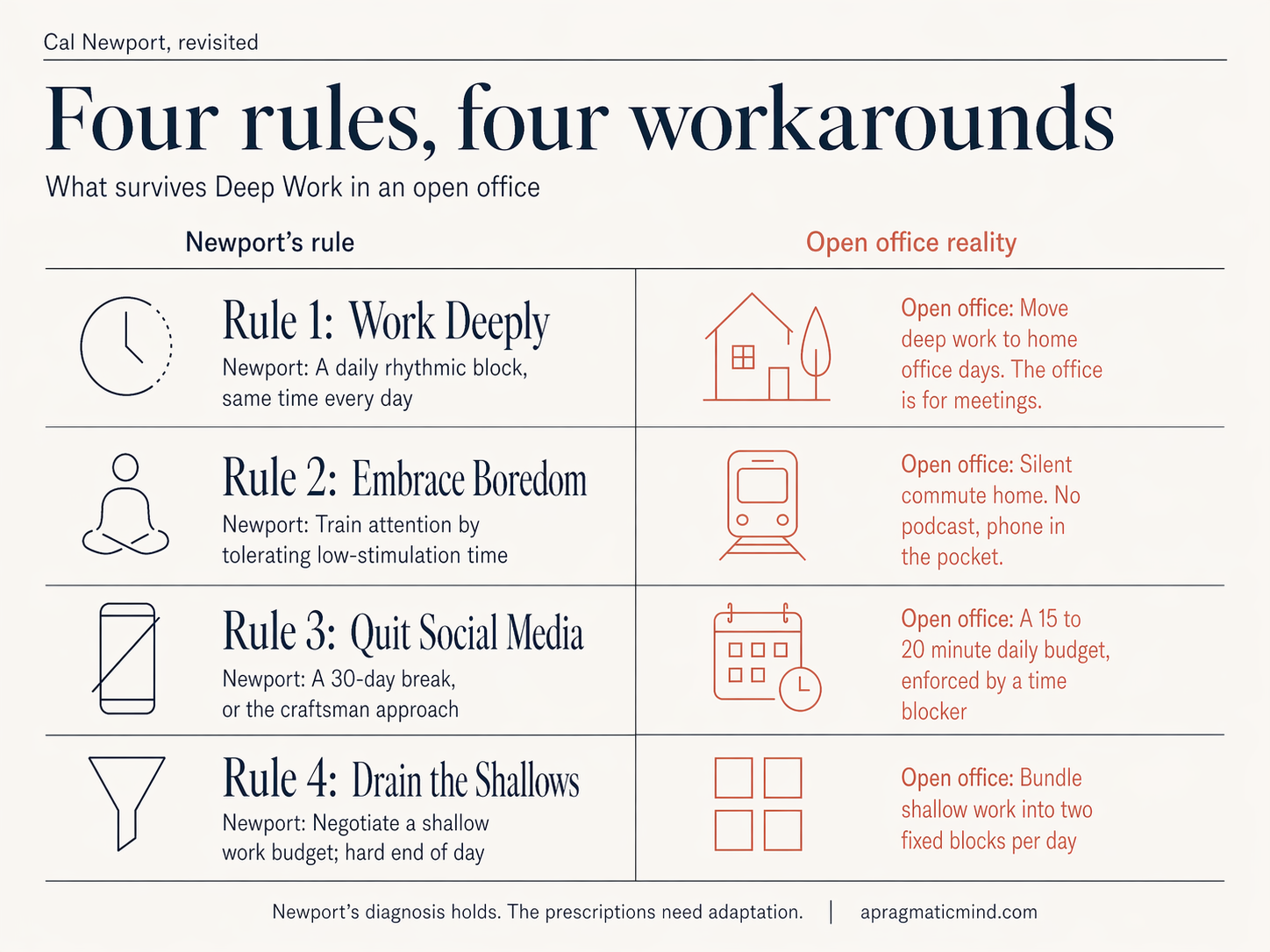
A side-by-side infographic comparing Cal Newport's four Deep Work rules with the workarounds that actually hold up in an open-plan office
A Short Recap of Cal Newport's Four Deep Work Rules
Newport's book has two parts. The first part argues why deep work matters. The central claim is that the ability to concentrate deeply is becoming both rarer and more valuable at the same time, and that most knowledge workers are losing it. The second part lays out four rules to rebuild the skill.
Rule 1, Work Deeply, is about scheduling. Newport offers four philosophies to choose from. The Monastic philosophy means cutting off contact with the outside world entirely, which suits writers on retreat but nobody in an employed role. The Bimodal philosophy means retreats of at least a full day, blocked off in advance. The Rhythmic philosophy means a fixed daily block at the same time every day, and this is Newport's recommended default for most people. The Journalistic philosophy means fitting deep work into whatever windows open up, which Newport describes as an advanced mode for people already trained in focused work.
Rule 2, Embrace Boredom, is not about work at all. It is about attention training. Newport argues that reaching for stimulation in every spare moment, such as pulling out the phone while waiting in a queue, conditions the brain against sustained focus. The practice he recommends is to sit with boredom deliberately, and to use open time such as a commute or a walk for productive meditation, meaning thinking through a single professional problem.
Rule 3, Quit Social Media, is about digital tools. Newport offers two paths. The strict version is a complete thirty-day break from all social platforms. The milder version is what he calls the craftsman approach: keep a tool only if its substantial benefits clearly outweigh its substantial costs for the work that matters. Both paths are about regaining control of attention from services engineered to capture it.
Rule 4, Drain the Shallows, is about minimizing the kind of work that does not produce new value. Shallow work in Newport's sense means routine email, administrative coordination, quick replies, anything that keeps you busy without moving a meaningful project forward. His main proposals here are a shallow work budget negotiated with your manager, typically thirty to fifty percent of total time, and fixed-schedule productivity, meaning a hard end to the workday that forces better choices about what fills it.
That is the book. One rule about the work. Three rules about the environment around it. Each rule carries assumptions about control over time, tools, and communication. In an open office, those assumptions break one by one.
-
Cal Newport's four rules of deep work are Work Deeply, Embrace Boredom, Quit Social Media, and Drain the Shallows. The first rule is about scheduling focused work using one of four philosophies: Monastic (full retreat), Bimodal (retreats of a day or more), Rhythmic (a daily fixed block, Newport's recommended default), or Journalistic (fitting deep work into windows as they open). The second rule is about training attention by tolerating boredom. The third rule is about using digital tools only when their substantial benefits outweigh their substantial costs. The fourth rule is about minimizing shallow work through a negotiated shallow work budget and a fixed daily end time.
Deep Work Rule 1: Work Deeply (and Why Rhythmic Scheduling Fails in Most Organizations)
What Newport proposes. Rule 1 offers the four philosophies described above, with Rhythmic scheduling as the recommended default for most people. A daily block of deep work, same time every day, protected against interruption.
Where it breaks in an open office. Rhythmic scheduling fails because of hierarchy. In most organizations, the manager's time has priority over the individual's plan. When the manager has a spontaneous window, the direct report is expected to have one too. The same applies one level above. If someone senior wants to discuss a decision, turning them down is technically possible, but it comes at a cost. The cost is access. Declining means waiting two or three days for the next window. Over time, most people stop declining.
I have seen a company-wide Rhythmic block work exactly once. A startup of roughly five hundred employees blocked Tuesday and Thursday mornings as no-meeting time. The practice held because the CEOs kept to it. In larger corporations I have seen similar rules introduced several times. The erosion pattern is always the same. The rule holds for three or four weeks. Then someone senior books a meeting during a blocked window. Others follow. Within a few months the block remains in every calendar, but nobody remembers what it was for. Rhythmic scheduling depends on a social contract enforced from the top down. When the top does not enforce it, the contract dissolves.
What I do instead. What works for me is closer to Newport's Journalistic philosophy, combined with rituals that reduce interruption without requiring anyone's agreement.
The biggest change was turning off notifications. All pop-ups and sounds are off in Outlook, Teams, and Slack. I have to actively open an app to see whether anything has come in. The only exceptions are direct messages from my manager or from one level above, which bypass the filter. Do not disturb is my default mode during working hours, and I switch it off only for scheduled calls.
For work that requires more than thirty minutes of uninterrupted thought, I move it to my home office days. Every Friday I plan the next week and decide which projects need depth. Those are scheduled against the one or two home office days I have that week. Office days become meeting days and shallow work days by design. The physical location becomes the signal. In the office, I do not attempt deep work at all. At home, I protect the hours as if they were the only ones that week. Often they are.
-
Yes, but usually in short, unpredictable windows rather than the rhythmic daily blocks Cal Newport recommends. Three of his four scheduling philosophies (Monastic, Bimodal, Rhythmic) assume calendar control or physical isolation, which open offices rarely allow. The Journalistic philosophy, which means catching deep work in windows as they open, is the one that realistically fits most open-plan environments. In practice, protected deep work often depends on moving it out of the office entirely, into home office days or early hours before meetings start.
Deep Work Rule 2: Embrace Boredom (and Where I Actually Train Attention)
What Newport proposes. Rule 2 is about building tolerance for boredom, which Newport frames as the foundation of sustained attention. If you reach for stimulation every time the mind wanders, concentration becomes harder over time. The practice is to use low-stimulation time, such as a walk or a commute, without filling it with podcasts, music, or scrolling.
Where it breaks in an open office. Boredom does not occur in an open office. Stimulation is constant and unwanted. Colleagues talk, phones ring, movement happens in every direction. There is no trainable state of waiting to be protected from your own reaching. The environment is already saturated. If Rule 2 is a training ground, the open office is the wrong location entirely.
This means the training has to happen outside the office. Newport does not say this explicitly, but it follows from his own argument about stimulation thresholds.
What I do instead. My training ground is the commute home. No podcast, no phone in hand, phone stays in my pocket. That is the whole rule. Everything else is unstructured on purpose. Sometimes my mind goes to the day: what happened, what I did not get to, what I will do tomorrow. Sometimes it drifts to a film I want to watch or a conversation I had last week. I do not prompt it toward reflection, because when I tried prompting I ended up adding another task to the end of an already long day. The unstructured version made the evening lighter rather than heavier.
Two of Newport's ideas end up sharing the same twenty-minute window. Rule 1 calls for a shutdown ritual to transition out of work. Rule 2 calls for boredom training. My commute does both. I should add that this works partly because I have an introverted temperament and find unstructured silence restful. Readers with a different temperament may need a different setup.
-
One to two hours per day is realistic for most knowledge workers, often split across shorter blocks. Cal Newport's own research suggests that even experienced practitioners rarely sustain more than four hours of deep work daily, and that assumes full control over the environment. In an open office with meetings, interruptions, and hierarchical demands, protecting even a single ninety-minute block is difficult without cross-team agreement on focus time. The realistic goal is one to two protected hours per day, not the four or more often referenced online.
Deep Work Rule 3: Quit Social Media (or Apply the Craftsman Approach)
What Newport proposes. Rule 3 gives two paths. The strict version is a complete thirty-day break from all social platforms. The craftsman approach asks whether a tool's substantial benefits outweigh its substantial costs for the work that matters. Only the tools that pass that test stay.
This rule deserves a note on timing. Newport was one of the first mainstream voices to argue for quitting social media, at a point when the recommendation was treated as extreme rather than reasonable. The book came out in 2016. A decade later, the same platforms are being discussed in legislative terms, with age restrictions for young users in several countries. The framing Newport proposed back then, that attention is a finite resource and that platforms are engineered to capture it, has aged well. Rule 3 is the part of the book that has gained relevance rather than lost it.
Where the strict version breaks. Quitting platforms entirely carries social and professional costs that Newport underestimates in the stricter version. In many roles, leaving LinkedIn means disappearing from conversations, networks, and opportunities. Messaging platforms now host parts of people's professional and social lives. A complete quit is technically possible, but it trades one set of costs for another. The craftsman approach is the realistic path for most professionals, which Newport also treats as the more general recommendation.
What I do instead. I take the craftsman approach seriously. Fifteen to twenty minutes a day across social platforms, enforced by a time blocker on my phone. That is enough to reply to people and stay in touch. Outside that window, the apps are locked, which removes the option to pick up the phone out of habit. The underlying point still holds: the platforms are designed to take more than they give. The only question is how strictly the budget is enforced.
-
No. Cal Newport offers two paths in Rule 3 of Deep Work. The strict version is a complete thirty-day break from all social platforms. The craftsman approach asks whether a tool's substantial benefits outweigh its substantial costs for the work that matters to you. For most professionals, the craftsman approach is the realistic option, because platforms like LinkedIn and messaging apps host professional networks that cannot be abandoned without meaningful loss. A strict daily time budget, for example fifteen to twenty minutes enforced by a time blocker, is usually enough to cut passive use without eliminating access.
Deep Work Rule 4: Drain the Shallows (Why I Bundle Shallow Work Instead of Minimizing It)
What Newport proposes. Rule 4 proposes two central practices. The first is a shallow work budget negotiated with the manager, typically thirty to fifty percent of total time. The second is fixed-schedule productivity, meaning a hard end to the workday that forces better choices about what fills the day.
Where it breaks in an open office. Both proposals assume a manager in a position to negotiate and willing to. In a matrix organization, that assumption often does not hold. Most managers have no clear idea what percentage of your work should be shallow because they do not know what shallow work means in your specific role. They also rely on you to respond quickly to their own requests, which creates an incentive against negotiating it down. The shallow work budget remains theoretical.
Fixed-schedule productivity has a related problem. A hard end time works when workload is under your own control. In organizations with distributed demands across teams and time zones, the end time can be held as a personal rule, but the volume of shallow work arriving each day does not necessarily change as a result.
What I do instead. Instead of minimizing shallow work, I bundle it. Email, Slack replies, short reviews, quick calls all go into two fixed blocks per day. One after lunch, one at the end of the day. The inbox stays closed outside those windows. Combined with the spatial separation from Rule 1, this produces a clearer division across the week. Shallow work happens in the office, which fits its environment. Deep work happens at home, which fits its environment.
Newport treats shallow work as volume to be reduced. My approach gives it a container instead. Once it has a container, it stops leaking into the rest of the day.
-
Deep work is cognitively demanding work performed in distraction-free concentration. It creates new value, improves skills, and is hard to replicate. Shallow work is logistical, non-demanding work such as email, routine coordination, and quick responses. It does not require focused attention and does not produce new value in the same way. Deep work compounds over time and drives long-term career growth. Shallow work tends to expand to fill whatever space it is given, which is why bundling it into fixed blocks produces better results than processing it as it arrives throughout the day.
What Survives from Newport's Deep Work in an Open Office
Newport's diagnosis survives the open office. Sophie Leroy's 2009 research on attention residue, which Newport draws on in the book, showed that when we switch tasks, part of our attention stays stuck on the previous one, and that this degrades performance on the next. The principle of least resistance still pushes organizational behavior toward visible busyness over actual output. The cost of interruption, both in time to recover and in the quality of output produced, is well documented.
The prescriptions need more adaptation. Rhythmic scheduling dissolved for me against hierarchy. Boredom training had to move out of the office and into the commute. Social media did not need a full quit but needed a strict budget. Shallow work did not need minimizing but needed a container.
The underlying principle is intact. The work that counts still needs its own room. When the room does not exist in the physical environment, it has to be built with time, with space, or by closing every notification channel at once as a starting point. Newport's book is still worth reading. It just needs to be read a second time, from a different chair than the one he wrote it in.
Sources
Newport, Cal (2016). Deep Work: Rules for Focused Success in a Distracted World. Grand Central Publishing.
Leroy, Sophie (2009). "Why is it so hard to do my work? The challenge of attention residue when switching between work tasks." Organizational Behavior and Human Decision Processes, 109(2), 168-181.
