What Is a Second Brain? A Pragmatic Guide to Modern Personal Knowledge Management
Reading time: 20 min; Short on time? See the concise definition in our glossary: → Second Brain Definition
What this guide covers:
- A second brain is a knowledge system, not a productivity system. It answers "what do I know?" while methods like GTD answer "what should I do next?" They solve different problems and work better together.
- The cognitive science is clear: your working memory holds about four items, disorganised information drains the capacity you need for real thinking, and a well-used external system genuinely extends what your mind can do.
- Four established methods compared honestly (PARA, Zettelkasten, Johnny.Decimal, LYT), including who each one fits, what it does well, and where it falls short.
You know you made a note about this. You remember the meeting where it came up, roughly what was said, maybe even who said it. But you cannot find the note. Not in the document you thought it was in. Not in Slack. Not in the email thread. Not in the notes app on your phone. So you do what you always do: you reconstruct it from memory, piece by piece, for the third time this month.
This is not a problem of intelligence or discipline. It is a structural problem. You are asking your biological brain to do something it was never designed for: store and retrieve thousands of information fragments across dozens of sources, on demand, without error. And when it inevitably fails, you blame yourself instead of the system.
A second brain is the system that solves this. Not a specific app, not a specific method, and not a concept invented by any single author. It is a deliberate, external structure that captures what matters, organises it so you can find it again, and frees your mind to do what it actually does well: think, connect, and decide.
This article is not another summary of one book. It is a pragmatic look at what a second brain actually is, what the science says about why it works, how it differs from productivity systems, and which of the four major methods might fit the way you think. If you are looking for a tool recommendation or a step-by-step setup tutorial, you will find pointers to those. But the real question this article answers is more fundamental: why does your brain need help, and what kind of help actually works? If you are curious why I write about PKM the way I do, this is the starting point.
What Is a Second Brain and How Is It Different from Note-Taking?
At its core, a second brain is an external system that stores, organises, and resurfaces your knowledge so your biological brain can focus on thinking, not remembering.
This is an important distinction. Note-taking is the act of writing things down. A second brain is what happens when those notes become part of a system that is structured, searchable, and reusable. The difference is similar to the one between journaling and keeping a diary: a diary records events, journaling processes them. In the same way, note-taking captures information, but a second brain makes it useful.
Consider the difference in practice. You sit in a meeting and write down three action items in a notebook. That is note-taking. Two weeks later, someone references a decision from that meeting, and you spend ten minutes flipping through pages trying to find it. Now imagine those notes live in a system where they are tagged, linked to the relevant project, and searchable. You find the decision in five seconds. That is a second brain at work.
The term "second brain" became popular through Tiago Forte, whose book Building a Second Brain gave the concept a clear name and a teachable structure. But the underlying idea is much older and much broader than any single framework. It sits within the field of Personal Knowledge Management (PKM), the discipline of how individuals capture, organise, connect, and use information. PKM is the broader practice. A second brain is one way to implement it: a personal, digital system designed to extend your memory and support your thinking.
You do not need to know or care about PKM as a discipline to benefit from a second brain. But understanding where it fits helps you see why the concept is more than a trend. It is a practical response to a real cognitive limitation, one that science has been studying for decades.
-
A second brain is a personal, digital system where you store everything worth remembering: notes, ideas, links, insights, and reference material. Instead of relying on your biological memory to keep track of thousands of information fragments, you put them in a structured place where you can find them again when you need them. Think of it as an external memory that is searchable, organised, and always available. The term was popularised by Tiago Forte, but the underlying idea, externalising knowledge so your mind can focus on thinking, is centuries old.
-
Not exactly. Personal knowledge management (PKM) is the broader discipline of how you capture, organise, connect, and use information. A second brain is one specific way to practice PKM: a digital system designed to extend your memory and support your thinking. You can practice PKM without calling it a second brain, and you can build a second brain without knowing the term PKM. They overlap significantly, but PKM is the field and a second brain is one application within it.
Why a Second Brain Is Not a Productivity System
This is a distinction that almost nobody makes clearly, and it matters more than it might seem at first.
Productivity methods like GTD, Pomodoro, Time Blocking, or the Eisenhower Matrix answer one set of questions: What should I do next? How do I organise my time? How do I get through my task list without losing focus?
A second brain answers a completely different set: What do I know? Where did I put it? How do I build on what I have already learned?
The first is about managing work. The second is about managing knowledge.
Here is what the difference looks like in practice. You sit down on Monday morning and block two hours for working on a quarterly report. That is productivity. But when you open the document and realise you need the insights from last month's strategy meeting, the data from a Slack thread, and the feedback your manager gave you three weeks ago, and you spend twenty minutes hunting for all of it, that is an organisation problem. Your time management was fine. Your knowledge management was not.
The two are not competing approaches. They are complementary. Productivity tells you when and what. Your second brain delivers the what with. Together, they create what most people are actually looking for: clarity. The confidence that you know what to do, you know when to do it, and you have everything you need to do it well.
If you have read The Best Productivity Methods or my GTD setup, you already have the productivity side covered. A second brain is the other half of the equation.
-
No. A second brain is a knowledge management system, not a productivity system. Productivity methods like GTD, Pomodoro, or Time Blocking help you manage your tasks and time. A second brain helps you manage what you know: your notes, ideas, references, and insights. The two are complementary. Productivity tells you what to do and when. Your second brain provides the knowledge and material you need to do it well. Together, they create clarity. Separately, each only solves half the problem.
The Science Behind It: Why Your Brain Needs an External System
Most articles about second brains make vague claims about "information overload" and leave it at that. The actual science is more specific, more interesting, and far more useful for understanding why external systems work. It comes down to three well-researched areas: the limits of working memory, how bad organisation makes you less effective, and why external systems are not a crutch but a genuine extension of your thinking.
Working Memory: Powerful, but Tiny
In 1956, cognitive psychologist George Miller published one of the most cited papers in the history of psychology: "The Magical Number Seven, Plus or Minus Two" (Psychological Review). Miller observed that human working memory, the system we use to hold and manipulate information in the moment, can handle roughly seven items at once. For decades, this was the accepted number.
In 2001, Nelson Cowan published a reanalysis in Behavioral and Brain Sciences that revised that estimate downward. His conclusion: the true capacity of working memory for young adults is closer to four chunks. Not seven. Four. And for children and older adults, even less.
Think about what this means in a typical workday. You are in a standup meeting. You are listening to a colleague describe a blocker. You are simultaneously thinking about what you will say when it is your turn. You are trying to remember the action item from yesterday. And you are making a mental note to follow up on an email you saw this morning. That is already four things. Your working memory is full. If someone now mentions a deadline change that you need to remember, something else has to fall out. Not because you are careless, but because four slots is all you have.
A second brain does not increase your working memory. Nothing does. What it does is reduce the demand on it. When you capture information externally, you free up slots for actual thinking: analysis, connection, decision-making. The things your brain is genuinely good at.
Cognitive Load: Why Bad Organisation Makes You Dumber
In 1988, educational psychologist John Sweller introduced Cognitive Load Theory (Cognitive Science), which has since become one of the most influential frameworks in instructional design. The core idea: your brain has a limited pool of cognitive resources, and how those resources are spent determines how well you think and learn.
Sweller distinguishes three types of cognitive load. Intrinsic load is the inherent complexity of what you are working on. Extraneous load is everything that drains mental energy without contributing to understanding: distractions, poor design, disorganised information. Germane load is the productive kind, the mental effort that builds real comprehension and insight.
The critical insight for anyone building a second brain: when extraneous load is high, germane load suffers. In other words, when you spend mental energy searching for information, navigating a chaotic folder structure, or trying to remember where you saved something, you have less capacity left for the actual thinking that matters.
Here is what that looks like in real life. You need a specific insight from a research article you read two weeks ago. You open your notes app. You scroll. You search. You open three different documents. You check your browser bookmarks. Ten minutes later, you either find it buried in the wrong folder or give up and re-read the article from scratch. Those ten minutes were not productive. They were pure extraneous load: cognitive resources burned on retrieval instead of reasoning.
A study by Fisher, Godwin, and Seltman (2014), published in Psychological Science, demonstrated this principle in a vivid way. Children learning science in a heavily decorated classroom stayed less focused and scored lower on tests than children in a visually sparse room. The decorations were not harmful in themselves, but they consumed working memory resources that would have been better spent on learning. The same principle applies to digital environments: a cluttered, unstructured knowledge system creates mental noise that competes with your ability to think clearly. If we want to understand better why we overthink and how to stop it I recommend you this article about it.
A well-organised second brain is, in cognitive load terms, a way to minimise extraneous load. It does not make the work easier. It removes the friction that sits between you and the work.
The Extended Mind: Why a Notebook Is Not Cheating
In 1998, philosophers Andy Clark and David Chalmers published a paper that changed how cognitive science thinks about the boundaries of the mind. "The Extended Mind," published in Analysis, argued that cognitive processes do not stop at the skull. When you rely on an external tool consistently and trust it as a reliable source of information, that tool becomes functionally part of your cognitive system.
Their classic thought experiment involves a man named Otto who has early-stage memory loss. He carries a notebook everywhere and consults it the same way most people consult their biological memory. Clark and Chalmers argued that Otto's notebook plays the same functional role as biological memory, and should therefore be considered part of his cognitive system, not merely an aid to it.
This is not just philosophy. It has a practical implication for how we think about second brains. An external system is not a workaround for a bad memory. When you build a reliable, well-structured knowledge system and use it consistently, it extends what your mind can do. Your brain handles the creative, associative, and analytical work. Your second brain handles the storage, retrieval, and organisation. Together, they form a system that is more capable than either one alone.
A Note on Honesty
The research on working memory limits and cognitive load is robust, built on decades of experimental work. The Extended Mind thesis is well-argued and widely discussed in cognitive science, though it remains a philosophical position rather than an empirical finding.
What the research does not tell us is which second brain method is objectively best. There are no randomised controlled trials comparing PARA to Zettelkasten, or Obsidian to Notion. The scientific principles are solid. The specific implementations are a matter of preference, context, and thinking style. Anyone who tells you otherwise is selling something.
-
Yes, though with an important nuance. The scientific support comes from three areas. Working memory research (Miller, 1956; Cowan, 2001) shows that your brain can only hold about four items at once, which is why externalising information helps. Cognitive Load Theory (Sweller, 1988) demonstrates that disorganised information drains mental resources that could be used for real thinking. And the Extended Mind thesis (Clark and Chalmers, 1998) argues that well-used external tools become genuine extensions of cognition. What the research does not tell us is which specific method or tool is objectively best. The principles are robust. The implementations are a matter of personal fit.
A Short History of Externalised Thinking
Humans have been building external thinking systems for centuries. The idea behind a second brain is not new. What changed is the scale of the problem and the power of the tools.
During the Renaissance, scholars kept commonplace books: personal collections of quotes, ideas, observations, and references, organised by theme. Francis Bacon and John Locke both used them systematically. These were the analogue predecessors of modern knowledge systems, built on the same instinct: capture what matters so you can reuse it later.
In the twentieth century, German sociologist Niklas Luhmann took this further than anyone before him. Over three decades, he built a Zettelkasten (slip box) of roughly 90,000 interlinked index cards. Each card held a single idea, written in his own words, connected to other cards through a numbering and reference system. The result: more than 70 books and 400 academic papers. His Zettelkasten was not a filing system. It was a thinking partner, and arguably the most successful implementation of an external knowledge system in academic history.
The digital era changed the landscape. Tools like Evernote and OneNote, starting in the 2000s, made digital note-taking accessible to everyone. For the first time, you could store thousands of notes, search them instantly, and sync them across devices. But a problem became visible: people collected far more than they ever used. Notes went in but rarely came out. Digital storage alone was not enough. What was missing was structure, connection, and a reason to return.
Around 2017, productivity expert Tiago Forte gave the concept a name that stuck. "Building a Second Brain" packaged the idea into a clear narrative with a teachable framework. Forte did not invent external knowledge systems, but he made them accessible to a broad audience by combining a strong metaphor ("your digital notes are an extension of your brain") with a simple workflow (CODE: Capture, Organise, Distill, Express) and an intuitive organisational structure (PARA: Projects, Areas, Resources, Archive). The phrase "second brain" spread quickly because it captured something people intuitively felt: their scattered digital notes already behaved like an additional memory. They just lacked intentional design.
Today, the conversation has expanded. Tools like Notion, Obsidian, Capacities, and Logseq have created an ecosystem of options. The community around personal knowledge management is more active than ever. And the core question has shifted from "should I build a second brain?" to "which approach fits the way I think?"
Four Methods for Your Second Brain: Which One Fits Your Thinking Style?
Just as there is no single right way to journal, there is no single right way to build a second brain. The method that works is the one that fits how you actually think and work, not the one that looks most impressive in a YouTube setup tour.
Below is a comparison of the four most established approaches. Each serves a different purpose, each has clear strengths and honest limitations, and each will be explored in more depth in a dedicated article.
| Method | Best for | Structure | Key Principle |
|---|---|---|---|
| Building a Second Brain / PARA (Tiago Forte) | Action-oriented professionals juggling multiple projects | Folder-based hierarchy | Organise by actionability, not by topic |
| Zettelkasten (Niklas Luhmann) | Researchers, writers, long-term thinkers | Networked atomic notes | Connect ideas into a growing web of knowledge |
| Johnny.Decimal (Johnny Noble) | People who need strict, predictable file structures | Number-based hierarchy | Every item has exactly one findable location |
| Linking Your Thinking / LYT (Nick Milo) | Visual thinkers who want flexible navigation | Maps of Content + links | Navigate knowledge through evolving maps |
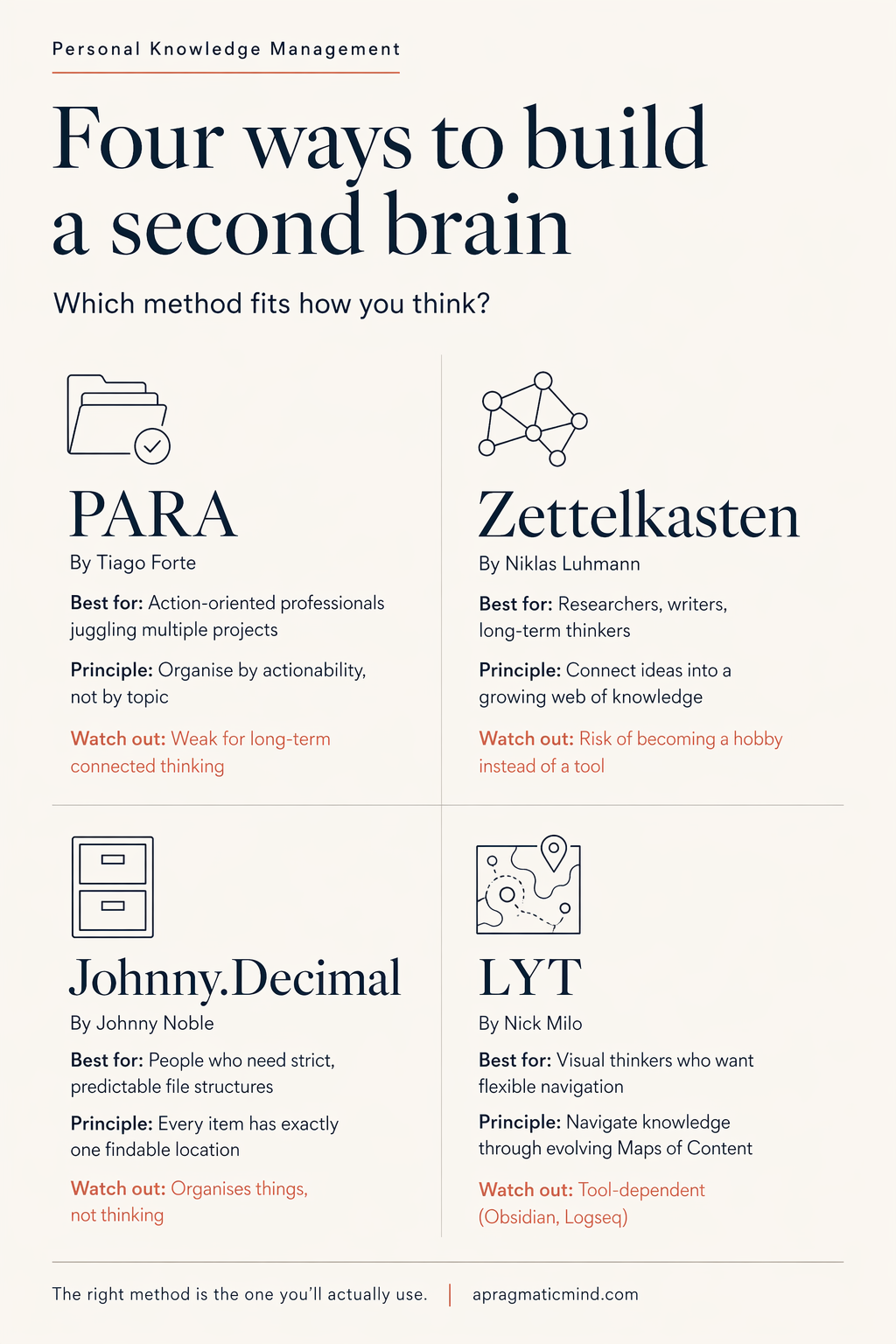
A comparision of methods how to build a second brain.
Building a Second Brain / PARA (Tiago Forte)
Forte's framework has two parts that work together. CODE describes the workflow: Capture information that resonates, Organise it where it will be most useful, Distill it to its essence, and Express it as creative output. PARA provides the organisational structure: Projects (active efforts with a deadline), Areas (ongoing responsibilities), Resources (topics of interest), and Archive (inactive material). CODE is the cycle of how information moves through your system. PARA is where it lives.
The strength of this approach is its low barrier to entry. You do not need a specific tool, technical knowledge, or a steep learning curve. PARA can be set up in any notes app in fifteen minutes, and CODE gives you a mental model for what to do with information once you have it. For anyone who manages multiple projects at work and needs a system that helps them find things by when they need them rather than by topic, this is often the fastest path to a working system.
The limitation is depth. PARA is optimised for action, not for building long-term understanding. It answers "which project needs this?" brilliantly, but it does not naturally support the kind of slow, connective thinking that emerges when ideas are linked over months and years. If your goal is to develop original insights rather than manage project materials, you may outgrow it.
For a complete walkthrough of how PARA works in practice, including setup steps and an honest look at where it runs into problems, read The PARA Method: A Pragmatic Guide.
Try it if: you juggle multiple projects, want a system you can start today without a learning curve, and care more about finding information when you need it than about building a knowledge network. Especially if you already use a productivity system like GTD and want something that complements it.
Zettelkasten (Niklas Luhmann)
The Zettelkasten method is built on a simple but powerful idea: one note per idea, written in your own words, linked to other notes through explicit connections. The system grows not by accumulating information but by developing your own thinking. Sönke Ahrens, in How to Take Smart Notes, popularised a three-tier structure: fleeting notes (quick thoughts to be processed later), literature notes (summaries of what you read), and permanent notes (your own ideas, expressed clearly enough to stand alone). The core principle is that every new note should be written with the question: how does this connect to what I already know?
The strength of Zettelkasten is compounding. Because notes are linked, the system becomes more valuable over time, not more cluttered. After months of use, you start finding connections between ideas from different domains that you would never have seen otherwise. For researchers, writers, and anyone who thinks for a living, this is transformative. Luhmann himself described his Zettelkasten as a "communication partner" that surprised him with unexpected connections.
The limitation is investment. The learning curve is steeper than PARA. Writing good atomic notes takes practice. And there is a real risk that the system becomes a hobby rather than a tool: you spend more time perfecting your note-linking than actually using the insights. Luhmann used his Zettelkasten to publish. If your system is not producing output, something has gone wrong.
For a step-by-step approach to the note-taking side of your second brain, read the guide to the Zettelkasten method.
Try it if: you want a system that gets smarter over time and helps you discover connections between ideas that would otherwise stay isolated. Especially if you write, research, or think as a core part of your work.
Johnny.Decimal (Johnny Noble)
Johnny.Decimal is a numbering system for organising your entire digital life. You divide everything into a maximum of ten areas (numbered 00-09 through 90-99). Each area holds up to ten categories. Each category contains numbered items (IDs). The result is a three-level structure where every file, note, and document has exactly one address: for example, 31.04 means area 30-39, category 31, item 04. No subfolders. No ambiguity. No searching.
The strength is predictability. You always know where something is, because there is only one place it can be. This works across platforms: the same numbering system can organise your files, your email, your notes, and your bookmarks. For people whose chaos is not in their ideas but in their files, this is remarkably effective. It is inspired by the Dewey Decimal Classification used in libraries, adapted for personal use.
The limitation is rigidity. The ten-per-level constraint forces discipline, which is the point, but it also limits flexibility. There is no natural mechanism for connecting ideas across categories. Johnny.Decimal organises things, not thinking. It is a filing system, not a knowledge system. For managing documents and files, it is excellent. For developing ideas and insights, you will need something else alongside it.
Try it if: you need a system where every file has exactly one predictable location, and your primary frustration is not a lack of ideas but the inability to find what you already have. Especially if your chaos lives in your file system, not in your notes.
Linking Your Thinking / LYT (Nick Milo)
LYT is built around Maps of Content (MOCs): dynamic overview notes that gather and connect related ideas without forcing them into rigid folders. Think of a MOC as an evolving table of contents for a topic, one that grows and reorganises itself as you add more notes. Milo's core workflow, which he calls ARC (Add, Relate, Communicate), emphasises the act of relating ideas to each other as the central practice. LYT works best in tools with backlink support, such as Obsidian or Logseq, where connections between notes are visible and navigable.
The strength of LYT is that it bridges the gap between Zettelkasten's bottom-up linking and the desire for top-down overview. MOCs give you a "map" of your knowledge without the rigidity of folders. For visual thinkers, this is powerful: you can see how ideas cluster, where gaps exist, and how different domains of your thinking connect. It feels more intuitive than pure Zettelkasten for people who want both freedom and orientation.
The limitation is tool dependency. LYT requires a tool with backlinks and ideally a graph view. In Notion or Apple Notes, the method loses much of its power. And as with Zettelkasten, the balance between building the system and using it requires honest self-monitoring. MOCs can become another form of overengineering if you are not careful.
Try it if: you like the idea of connected notes but want more visual navigation than Zettelkasten offers. Especially if you think in maps rather than lists, and you are willing to invest in a tool like Obsidian or Logseq.
-
Start with how you work, not with what looks impressive. If you manage multiple projects and want something immediately usable, PARA (Tiago Forte) has the lowest barrier to entry. If you write, research, or think for a living and want a system that develops your ideas over time, Zettelkasten is worth the investment. If your problem is finding files rather than connecting ideas, Johnny.Decimal brings extreme order. If you are a visual thinker who wants connected notes with navigable maps, LYT (Nick Milo) bridges structure and flexibility. There is no universal best method. The right one is the one that fits your thinking style and that you will actually use consistently.
-
Yes, and many experienced practitioners do. A common combination is using PARA as the organisational backbone for projects and areas, while applying Zettelkasten principles for notes that develop long-term ideas. Another approach is using Johnny.Decimal for file management alongside LYT for knowledge navigation. The key is to be deliberate about what each method handles. Problems arise when you try to force everything into one framework, or when combining methods creates more complexity than it resolves. Start with one method, use it until you understand its strengths and limitations, and then expand if needed.
Which Tool Fits Which Method?
The tool matters less than most people think. A consistent practice in Apple Notes will outperform an abandoned Obsidian setup every time. That said, some tools are better suited to certain methods than others.
| Tool | Works best with | Strengths | Watch out for |
|---|---|---|---|
| Notion | PARA / BASB | Databases, visual layouts, collaboration | No offline mode, can become complex quickly |
| Obsidian | Zettelkasten, LYT | Local-first, Markdown files, graph view, plugin ecosystem | Steeper learning curve, requires design investment |
| Capacities | PARA / BASB | Object-based, intuitive, low friction to start | Smaller ecosystem, fewer integrations |
| Apple Notes / Google Keep | Getting started, simple capture | Zero friction, available everywhere, no setup | No linking, no structure beyond basic folders |
| Logseq | Zettelkasten, LYT | Open source, outliner-based, block references | Less polished interface, smaller community |
The honest recommendation: pick the tool you will actually open on your worst day, not the one that looks most impressive on your best day.
One thing worth noting: tools change, methods stay. If you build your second brain on solid principles, you can switch tools without starting over. This is also an argument for tools that store your data in open formats like Markdown. Your notes should outlast any app.
-
There is no single best app. The right tool depends on your method and your habits. Notion works well for PARA and project-oriented systems. Obsidian is excellent for Zettelkasten and LYT because of its local-first approach, Markdown files, and backlink support. Capacities offers an intuitive, object-based experience for people who find Notion too complex. Apple Notes or Google Keep work surprisingly well for getting started with zero friction. The most important factor is not features. It is whether you will actually open the tool daily. A simple system you use consistently will always outperform a powerful system you abandon.
-
Yes. Apple Notes is a perfectly valid starting point. You can create an inbox, organise notes into folders for active projects, reference material, and archive, and use the search function to find things quickly. What Apple Notes lacks is linking between notes, backlinks, and the kind of networked structure that methods like Zettelkasten or LYT rely on. So it works well for a simple PARA-style setup or a basic capture system, but if you want to build connections between ideas over time, you will eventually want a tool with more linking capabilities. Start with what you have. Upgrade when you outgrow it, not before.
Why Most Second Brains Fail
Most second brains do not fail because the concept is wrong. They fail because the implementation becomes heavier than the problem it was meant to solve.
Collecting without using. You have 700 notes. You have 40 saved articles. You have a dozen screenshots stored "for later." But in the last three months, you have not revisited a single one. This is not a second brain. It is a digital attic. The value of a system is not measured by what goes in. It is measured by what comes back out.
Overengineering. The Notion dashboard with eight linked databases, custom properties, rollups, and a weekly review template that you stopped using in week three. If maintaining the system takes more effort than it saves, the system is too complex. A second brain should reduce friction, not create a new kind of it.
No distillation. Raw notes pile up, but the core insight is never extracted. When you open a note six months later and need five minutes to figure out what the point was, you have not distilled. A well-maintained system surfaces the signal, not the noise.
Building for your ideal self. Designed for the version of you that reads thirty books a year, writes daily, reviews weekly, and links everything with perfect atomic notes. A second brain must survive bad weeks, not just good ones. If the system collapses the moment life gets busy, it was built for a fantasy, not for reality.
What I Learned from Getting It Wrong
I should be transparent about this because I made exactly these mistakes. When I first set out to build a second brain, I did what most people do: I spent weeks designing the "perfect" structure before I had captured a single useful note. I created elaborate folder hierarchies, detailed tagging systems, and category structures for topics I had never written about. It felt productive. It was not.
After a month, I had two things: a beautifully designed system and dozens of empty folders. The structure was so complex that I could not remember my own logic. Every time I wanted to save something, I had to think about where it belonged, and that friction was enough to stop me from doing it at all.
The turning point was a simple decision: I moved everything into an archive folder and started over. Not because the old system was worthless, but because it was not working. And the most important lesson I took from that experience is this: never delete, always archive. The moment you give yourself permission to archive everything and begin fresh, the pressure disappears. You are not losing anything. It is all still there. You are just admitting that the current structure is not serving you.
What surprised me was how rarely I actually went back to the archived material. That told me something valuable: most of what I had been organising so carefully was not as important as I thought. The things that truly mattered surfaced again naturally when I started with a simpler system.
Today, my approach is much lighter. An inbox for everything new. Three basic areas for active work, reference material, and archive. And the willingness to treat every setup as a tiny experiment: try it for a few weeks, see what works, adjust. Not a permanent commitment to a perfect system, but a series of small, honest iterations. That mindset changed everything.
-
Usually because the system has become more complex than the problem it was designed to solve. The most common causes: collecting information without ever using it again, building elaborate structures before knowing what you actually need, and designing a system for your ideal self instead of your real life. A second brain should make things lighter, not heavier. If yours feels overwhelming, consider archiving everything and starting fresh with the simplest possible setup: one inbox and three areas (active, reference, archive). You are not losing anything by archiving. You are giving yourself permission to begin again with less pressure.
-
Then do not build a complex system. The best second brains are low-maintenance by design. A simple setup with an inbox, a few project folders, and an archive takes almost no time to maintain. The weekly effort should be measured in minutes, not hours. If your system requires a dedicated "maintenance session" just to keep it functional, it is overengineered. Capture throughout the week, do a quick sort when you have five minutes, and archive anything you no longer need. That is enough. Complexity is not a sign of a good system. Usability is.
How to Start in 15 Minutes (Without the Perfect System)
The biggest obstacle to building a second brain is not choosing the wrong method. It is waiting for the right one. You do not need the perfect system to start. You need a starting point that is simple enough to actually use.
Step one: choose a tool you already have. Now is not the moment for a new app. Apple Notes, Notion, Obsidian, a Google Doc, it does not matter. The only requirement is that you can open it without friction. If you already use something daily, use that.
Step two: create one inbox. A single place where everything goes. Ideas, links, notes from meetings, half-formed thoughts, screenshots. No structure, no sorting, no categorising. Just capture. The goal is to build the habit of getting things out of your head and into your system.
Step three: create three areas. Active (what you are working on right now), Reference (what you want to keep but do not need immediately), and Archive (what is done or inactive). That is enough structure to start. You can refine later.
Step four: capture for one week, then review. Spend a week putting everything into your inbox. At the end of the week, look at what accumulated. Move things into Active, Reference, or Archive. Notice what you captured a lot of. Notice what you never looked at again. The structure will emerge from your actual behaviour, not from a theoretical framework.
Once you have a basic system running and it feels natural, explore which of the four methods described above fits your thinking style. The methods are the next step, not the first one.
Conclusion: A Second Brain Is a Thinking Tool, Not a Productivity Hack
A second brain is not about being more productive. It is about thinking more clearly in a world that produces information faster than any human mind can process on its own.
The science is straightforward. Your working memory holds about four things at once (Cowan, 2001). Bad organisation drains cognitive resources that could be used for real thinking (Sweller, 1988). And a well-maintained external system does not just assist your mind. It extends it (Clark and Chalmers, 1998).
But the method matters less than the practice. Whether you use PARA, Zettelkasten, Johnny.Decimal, or LYT, the principle is the same: get information out of your head, put it somewhere you trust, and make it findable when you need it. The system that works is the one you actually use, not the one that looks best in a screenshot.
If you are just starting, keep it simple. An inbox, three areas, and the willingness to iterate. If you want to go deeper, explore the methods, find the one that matches how you think, and treat it as an experiment, not a commitment. And if your current system is not working, do what has worked for me: archive everything, start fresh, and begin smaller than you think you should.
Your mind thinks. Your second brain remembers. Together, they let you work with more clarity and less noise.
For a deeper dive into the tools and ideas behind personal knowledge management, see The Best PKM Books. For the complementary side of the equation, how to manage your work and time, see The Best Productivity Methods.
Sources
Clark, A. & Chalmers, D. (1998). The Extended Mind. Analysis, 58(1), 7-19.
Cowan, N. (2001). The Magical Number 4 in Short-Term Memory: A Reconsideration of Mental Storage Capacity. Behavioral and Brain Sciences, 24(1), 87-185.
Fisher, A. V., Godwin, K. E., & Seltman, H. (2014). Visual Environment, Attention Allocation, and Learning in Young Children: When Too Much of a Good Thing May Be Bad. Psychological Science, 25(7), 1362-1370.
Miller, G. A. (1956). The Magical Number Seven, Plus or Minus Two: Some Limits on Our Capacity for Processing Information. Psychological Review, 63(2), 81-97.
Sweller, J. (1988). Cognitive Load During Problem Solving: Effects on Learning. Cognitive Science, 12(2), 257-285.
Sweller, J., van Merriënboer, J. J. G., & Paas, F. (2019). Cognitive Architecture and Instructional Design: 20 Years Later. Educational Psychology Review, 31, 261-292.
