The Psychology of Procrastination Answers the Wrong Question
Reading time: 15 minutes, last updated: April 2026
What you will find here:
- The psychology of procrastination is half the answer. Emotion regulation explains why people procrastinate in general, but not why you procrastinate this specific task and not that one.
- Four task types trigger procrastination systematically in complex organizations: role-ambiguous, role-conflicting, identity-exposing, and shapeless. Each has a different structural signature and a different first move.
- A four-step protocol for the next time you are stuck: diagnose the type, make the structural move, only then apply emotion regulation tools, and watch the pattern over two weeks.
The Moment Before Doing
It is Wednesday, 3:47 PM. The Slack message to your manager has been sitting in your drafts since Monday. You will write it tomorrow.
Earlier today, you closed three tickets, rewrote a project brief, and pushed a deck to the review channel. You did not procrastinate any of those.
The standard psychology of procrastination has a clean answer for why you are stuck on that Slack message. It is about emotion regulation. You are avoiding a task that triggers discomfort. That answer is correct. It is also incomplete, because it explains why people procrastinate in general, but it does not explain the specific thing happening in your day: you do not procrastinate everything. You procrastinate this.
For two decades, procrastination research has converged on a single explanation: procrastination is a problem of emotion regulation, not time management. The research is solid. The conclusion is correct. It has changed how productivity gets discussed. If you work in a complex organization, though, it only gets you halfway. Because the real question in your day is not "why do I procrastinate?" It is "why do I procrastinate this email, but not that report?"
The standard answer does not address the pattern. And the pattern is what matters.
What the Standard Answer Gets Right
The emotion regulation frame is not wrong. It replaced a worse explanation.
For most of the 20th century, procrastination was treated as a time management problem or, worse, a character flaw. Then Tim Pychyl and Fuschia Sirois, two researchers who have spent their careers on this question, established something different. Sirois and Pychyl (2013) showed that procrastination is a strategy for regulating short-term mood. When a task triggers aversive feelings, the mind defaults to avoidance because avoidance works in the short term. The discomfort disappears. The task remains.
Blunt and Pychyl (2000) examined 30 dimensions of what makes a task feel aversive and found that boredom, frustration, and task resentment were the strongest predictors. Steel's (2007) meta-analysis across decades of research quantified the relationship: task aversiveness correlates with procrastination at r = 0.40. That is a substantial effect size in social psychology. The emotional explanation has earned its place.
Sirois has continued to refine this in later work, showing that procrastination is particularly likely to spike in stressful contexts (Sirois, 2023). When coping resources are depleted by ongoing stress, the threshold for tolerating task-related negative emotions drops, and more tasks get deferred.
This is why the advice that follows from the research is consistent: self-compassion, implementation intentions, task breakdown, reducing the emotional cost of starting. All of this works, for the specific problem it addresses.
The problem is what it leaves unexplained.
Consider the Wednesday scenario again. The standard frame tells you that the Slack message carries some emotional weight the other tasks do not. True. But it does not tell you what kind of weight. Fear? Frustration? Perfectionism? Those are different states with different interventions, and without knowing which, you are throwing emotion regulation tools at an unspecified target. More importantly, the standard frame treats the task as a fixed thing that you have feelings about, when the task itself may be the structural problem.
-
Yes, but incompletely. Research by Sirois and Pychyl (2013) established that procrastination is primarily a short-term mood repair strategy, driven by aversive feelings tied to a specific task. However, emotion regulation explains why people procrastinate in general, not why a given person procrastinates certain tasks and not others. For knowledge workers in complex organizations, the emotional explanation often misses the structural reason: the task itself may be ambiguous, conflicting, or identity-exposing in ways that make delay a rational response rather than an emotional one.
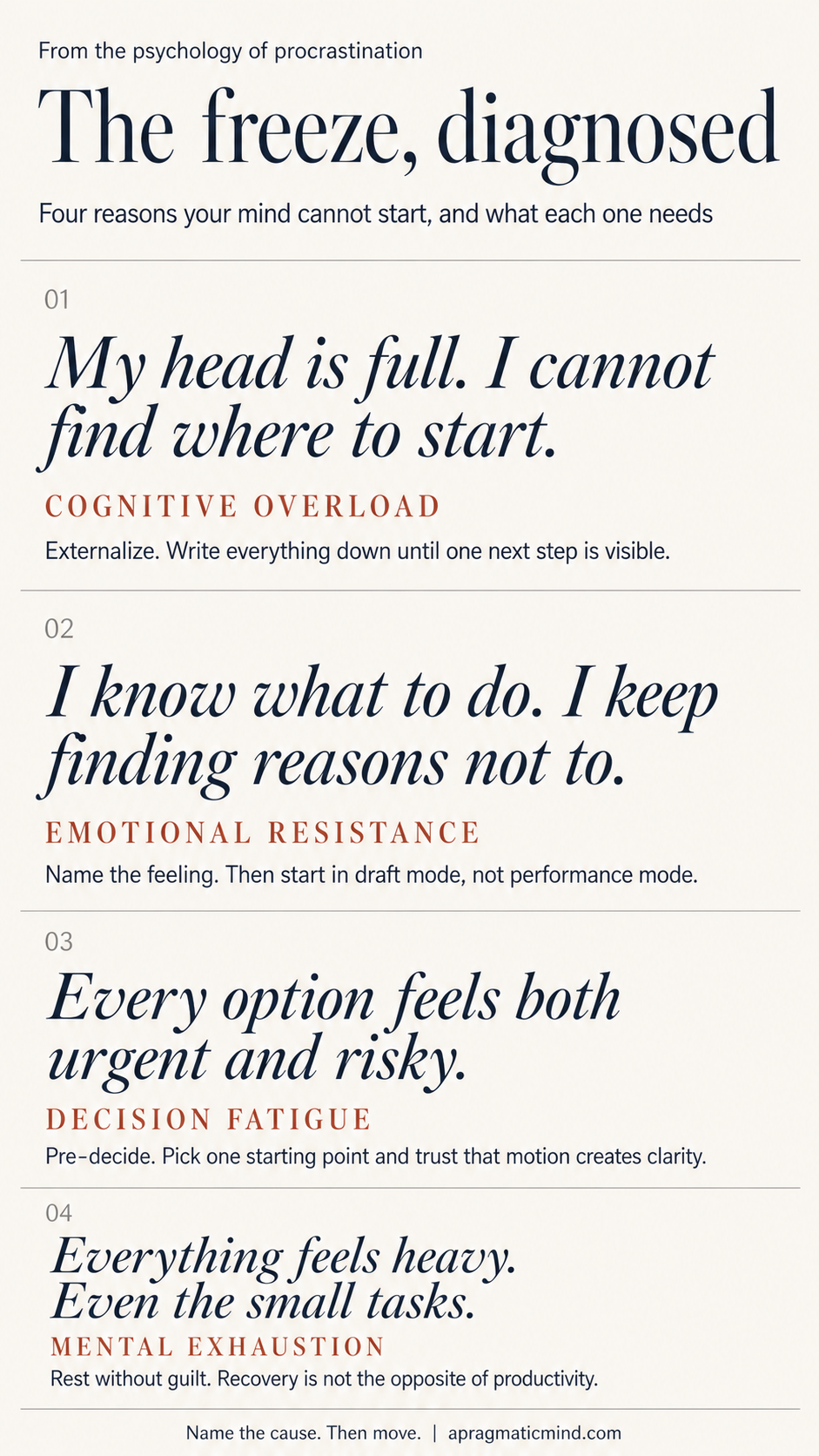
The Question the Standard Psychology Does Not Ask
If procrastination were purely about emotion regulation, you would procrastinate everything. You do not. You dispatch most of your day without drama. You write emails, update trackers, push code, sit in meetings, file reports. The procrastination happens on specific tasks, and those tasks have something in common that is not just "they make you uncomfortable."
The question the standard psychology does not ask is: what is it about this task, specifically, that is making my brain pull back?
That question changes the frame entirely. Instead of asking what is wrong with you, it asks what is different about the task. And when you start looking at the tasks in your day with that filter, a pattern shows up. Knowledge workers in complex organizations do not procrastinate randomly. They procrastinate four types of tasks, systematically, and those four types share structural features that have nothing to do with willpower or perfectionism.
I started noticing this after years of trying the standard advice. Self-compassion did not help me send a feedback email to a director three levels above me. The Pomodoro technique did not help me move forward on a proposal that sat between my function and another function, with neither ready to own the decision. Task breakdown did not help me start a project my manager had described as "do something with AI." The tools were well-validated. They were just being applied to the wrong problem. The first move was not to manage the emotion. It was to diagnose the task.
-
Because not all tasks are structurally equivalent. Research on task aversiveness (Blunt and Pychyl, 2000) identified specific characteristics that reliably trigger procrastination: ambiguity, lack of structure, and frustration. In workplace contexts, role theory (Rizzo et al., 1970; Gilboa et al., 2008) adds two more: role ambiguity (unclear ownership or expectations) and role conflict (contradictory demands from different stakeholders). When a task has these features, procrastination is often a rational response to structural problems rather than an emotional failure.
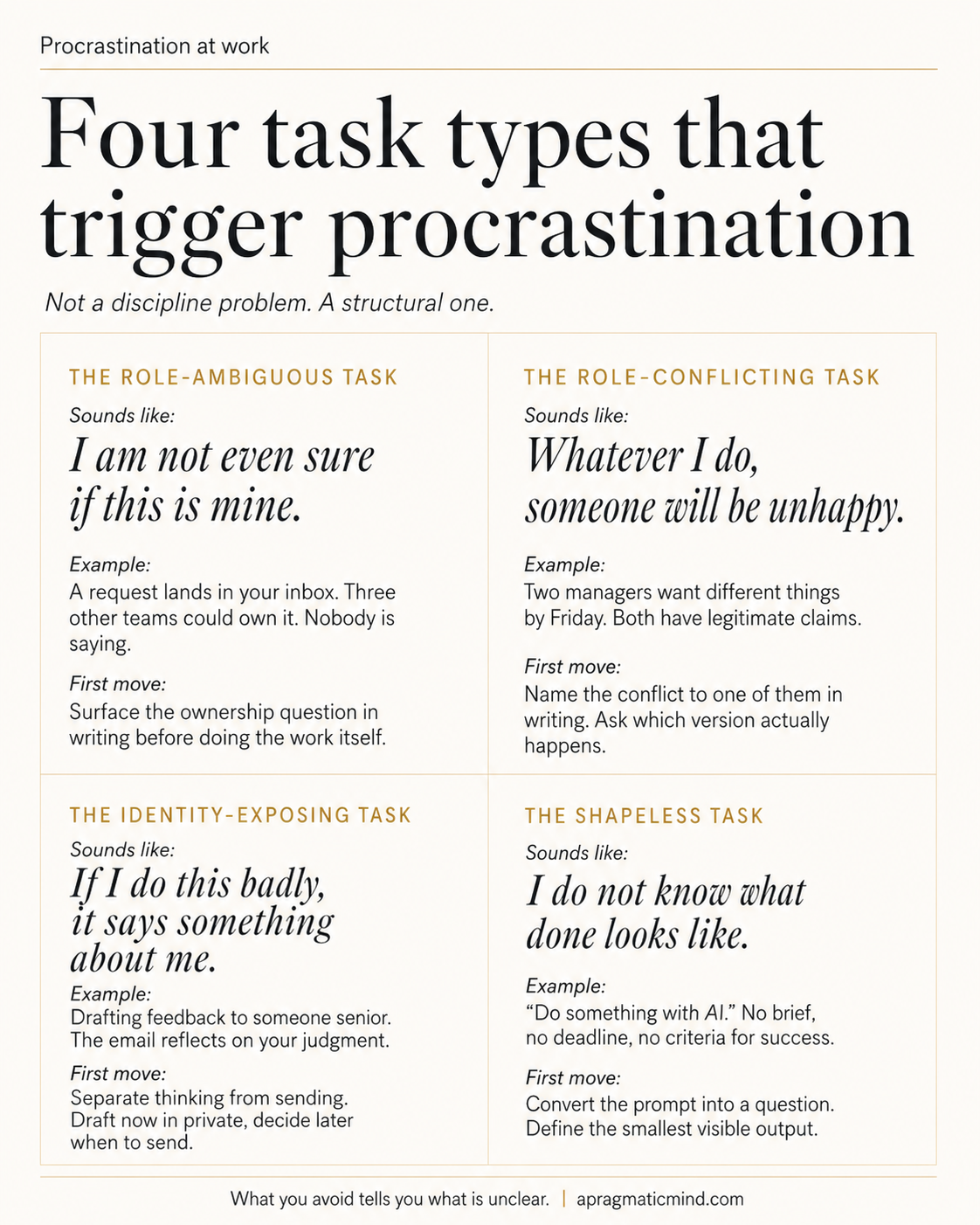
Four Task Types That Knowledge Workers Systematically Procrastinate
Type 1: The Role-Ambiguous Task
A task is role-ambiguous when you cannot clearly answer one of these: who owns this decision, who needs to approve it, or what "done" actually looks like.
This type is the most common in large organizations and the least recognized in procrastination literature. Rizzo, House, and Lirtzman (1970) defined role ambiguity as the absence of clear information about expectations and authority in a work situation, and developed the Role Questionnaire that is still in use today. Gilboa et al. (2008) meta-analyzed decades of workplace research and found that role ambiguity has a moderate negative correlation with performance across industries. Separately, Blunt and Pychyl (2000) identified ambiguity as one of the strongest predictors of task aversiveness in their 30-dimension study. The two research streams converge on the same point: when a task is unclear, the mind defaults to delay.
Here is what this looks like in practice. You have been asked to prepare a recommendation about tooling for your function. Your manager mentioned it in passing. You are not sure if this goes to the VP, to the procurement team, or stays in your own team. You do not know if "recommendation" means a slide, a decision memo, or a full business case. You do not know whether your regional manager needs to sign off, or whether this is your call. Every time you open the file, you start drafting, then stop because you do not know who the audience is. After three days, you have not written 200 words.
What your brain knows is that the task is structurally unfinished. It has no clear owner, no clear audience, no clear "done" state. Starting in that state produces output likely to be wrong for whoever actually needs it. The delay is not an emotion regulation failure. It is your brain refusing to burn energy on a moving target.
The first move is not to start the task. It is to resolve the ambiguity. Send one short message to the most likely owner. "Quick check before I go deeper: is this for our team's discussion, or does it go to [name]? And what format is most useful?" That message takes 90 seconds. The task you have been avoiding for three days now has edges.
-
Because your brain reads unclear expectations as a signal that starting will likely waste effort. Research on role ambiguity (Rizzo et al., 1970) shows that when people do not know what is expected of them, task completion suffers even when effort is high. In procrastination terms, this means delay can be an efficient response rather than an emotional failure. The solution is clarification, not motivation or self-compassion. One short message to the person most likely to own the decision often unblocks the task in minutes.
Type 2: The Role-Conflicting Task
A task is role-conflicting when two people or functions want you to do different things, and both have legitimate authority over your work.
Rizzo et al. (1970) distinguished role ambiguity (unclear expectations) from role conflict (contradictory expectations). Role conflict is what happens in a matrix structure by design. You have a direct manager, and you have a dotted-line stakeholder, and they do not fully agree on what you should be working on or how. Kahn et al. (1964) described this as the normal friction of organizational life. Normal, but it still triggers procrastination reliably.
Here is what this looks like. Your direct manager wants you to push a project forward this quarter, fast, visible, with results before the next steering committee. Your regional stakeholder, who has dotted-line authority and will be CC'd on every major email, wants the opposite. Slower. More stakeholder alignment. Less visibility until the numbers are right. You have been told both things in separate meetings. Neither person has seen the other's feedback. The first email you send will choose a direction implicitly. You keep reopening the draft and closing it. Two weeks pass.
What your brain knows is that there is no correct answer you can produce alone. Any move you make resolves the conflict in favor of one stakeholder, which creates friction with the other. The procrastination is not avoidance. Your brain is recognizing that this is not your conflict to resolve.
The first move is not to draft a compromise. It is to make the conflict visible. One short message to both stakeholders, on the same thread: "I want to make sure I am aligned before I move forward. Direct manager asked for approach A with timeline X, regional stakeholder mentioned approach B with a different emphasis. Can I get a quick confirmation of which takes priority?" The message feels risky. It is also the only move that does not leave you absorbing a conflict that is not yours.
This is the type that most productivity advice breaks on. No amount of self-compassion or Pomodoro technique will produce a right answer to a task that structurally does not have one. The task needs to go back up before it can go forward.
Type 3: The Identity-Exposing Task
A task is identity-exposing when the outcome changes how specific people with authority over you will perceive your competence, and the consequences are difficult to reverse.
This is the type that comes closest to the classic emotion regulation frame, but with a structural twist. Rohrmann, Bechtoldt, and Leonhardt (2016) studied procrastination as a defensive response for people with impostor self-concepts. Their finding: delay allows the task-doer to attribute potential failure to insufficient preparation time rather than to lack of ability. The delay protects the self-concept. Sirois (2023) describes this as a specific case of emotion regulation in high-stakes contexts, where the task-related emotion being regulated is threat to identity.
Here is what this looks like. You need to send a feedback email to a director three levels above you about a decision you think is wrong. You have drafted it. Edited it. Deleted it. Rewrote it softer, then stronger, then softer again. It is Friday afternoon. The decision goes live Monday morning.
What your brain knows is that once you send this, it is in writing. Every word is available forever to someone with significant authority over your career. The delay is your brain reading the stakes correctly and refusing to commit without reducing them.
The first move is not to send it. It is to reduce the stakes before sending. Two options work. One, produce a minimal version that only a trusted peer sees, and get one sanity check before it becomes public. Two, change the channel, because a 15-minute conversation will often let you test the message before it goes in writing, and a conversation is usually the higher-leverage move. Most identity-exposing tasks stay stuck because people try to perfect the high-stakes version instead of creating a low-stakes version first.
Standard advice works here, but only after the stakes are reduced. Sirois' self-compassion frame is valid once the task is no longer a bet-the-reputation move. If you go straight to self-compassion on the full version, you are trying to feel better about a risk that is actually there.
-
Important work tasks often share characteristics that reliably trigger procrastination in ways minor tasks do not. They are more likely to be role-ambiguous (unclear owner), role-conflicting (contradictory stakeholders), or identity-exposing (high visibility with authority). Research on role stress (Gilboa et al., 2008) and defensive delay (Rohrmann et al., 2016) shows that these structural features produce systematic avoidance even in people who are not generally procrastinators. Importance correlates with structural complexity, which correlates with procrastination. The fix is usually structural clarification, not motivational.
Type 4: The Shapeless Task
A task is shapeless when it has no clear first step, no defined end state, and no template to follow.
Blunt and Pychyl (2000) identified "unstructured" as one of the strongest dimensions of task aversiveness. Lay (1992) showed that lack of structure and lack of autonomy correlate with procrastination independently of perfectionism or impulsivity. The mechanism is straightforward: a task without structure requires you to generate the structure before you can execute, which is cognitively more expensive than most people budget for.
Here is what this looks like in 2026. Your manager says, in a 1:1, "It would be good if you did something with AI." No brief. No deliverable. No budget. No audience. You leave the meeting nodding, put it on your list, and then do not touch it for three weeks. When you do open a blank document, you spend 20 minutes rereading your notes from the 1:1, close the document, and check Slack.
What your brain knows is that you have been asked to complete an undefined task. Starting without a definition means producing something your manager might look at and say, "that is not really what I meant." The delay is your brain refusing to do both the scoping and the execution under the label of execution.
The first move is not to produce something. It is to scope the task as a separate piece of work. Block 20 minutes. Write down: what problem is this solving, what outcome would count as success, who is the audience, what is the smallest version that tests the idea. Send that scoping note to your manager before doing any real work. "Before I invest further, is this the shape you meant?" Nine times out of ten, your manager will refine the scope. One time out of ten, they will say "yes, go." Either way, you are not executing against a blank brief anymore.
Shapeless tasks are the most common type for mid-career knowledge workers with any degree of autonomy. The procrastination response is actually a form of competence, refusing to waste hours on a task whose shape you do not yet know.
A Simple Diagnostic When You Are Stuck
When you notice you are procrastinating a specific task, stop trying to diagnose your emotional state for a minute. Run these four questions first:
1. Is it clear who owns this task, and what "done" looks like? If no, it is role-ambiguous. The first move is clarification, not execution.
2. Are two or more people with authority over me expecting different things from this task? If yes, it is role-conflicting. The first move is surfacing the conflict, not building a compromise.
3. Does the outcome significantly change how specific people perceive my competence, in ways that are hard to reverse? If yes, it is identity-exposing. The first move is reducing the stakes, not perfecting the output.
4. Could I write down the next three concrete steps of this task right now, in one sentence? If no, it is shapeless. The first move is scoping, not executing.
If none of these apply and the task is structurally clean, then the standard psychology has it right. You are probably procrastinating because of emotional aversiveness, and the well-established toolkit applies: self-compassion, implementation intentions, task breakdown. These tools are empirically validated (Schuenemann et al., 2022; Sirois, 2014). They work on the problem they were designed for.
The order matters. Structural diagnosis first, emotion regulation second. If you start with emotional work on a task that is actually ambiguous, the best you can do is feel better about pushing a boulder that should not be pushed yet. The boulder is still there, still not moving, and now you have added a layer of self-work that was not the real issue.
If you also find yourself stuck in rumination about why a task feels hard, that is a separate pattern. I covered it in my article on how to stop overthinking, which complements the structural diagnosis above.
-
Run a structural diagnostic first. If the task has unclear ownership (role-ambiguous), contradictory stakeholders (role-conflicting), high-stakes visibility (identity-exposing), or no defined shape (shapeless), it is structurally complex and delay is likely a rational response. If none of those features are present and you still cannot start, then the issue is likely emotional (task aversiveness in Blunt and Pychyl's 2000 terms), and standard tools like self-compassion and implementation intentions apply. The mistake most knowledge workers make is starting with emotional tools on structurally complex tasks, which does not resolve the underlying problem.
When the Standard Psychology Is Right
I do not want to overstate this. Not every procrastination episode is structural. Some tasks are genuinely just aversive in the emotional sense, and for those, Sirois and Pychyl's framework is the right frame and the right toolkit.
Here is how I tell the difference. If I am avoiding one specific task, and that task is not ambiguous, conflicting, identity-exposing, or shapeless, then the issue is probably emotional. Maybe the task is boring. Maybe it triggers a sense of inadequacy I have not examined. Maybe it is connected to an outcome I am afraid of. In those cases, self-compassion helps, implementation intentions help, and task breakdown helps. The research on all three is solid.
If, on the other hand, I notice I am procrastinating a whole category of tasks, emails to senior stakeholders, cross-functional proposals, strategic recommendations, then it is not an emotional pattern. It is a structural one. Something about how my role is defined, or how decisions get made around me, is producing systematic friction. That is not a self-compassion problem. That is a role clarification problem, a workflow problem, or a scope problem.
The distinction is practical, not theoretical. Emotional procrastination responds to emotional tools. Structural procrastination responds to structural moves. Applying the wrong tool wastes effort, and often adds guilt, because when self-compassion does not work, people conclude that they are broken rather than that they have misdiagnosed the problem.
If you want a way to track which pattern shows up for you over time, reflective journaling is the cleanest method I have found. Write down the specific task you are avoiding, and one line about which of the four types it looks like. Over a few weeks, the pattern becomes visible.
-
Procrastination is the voluntary delay of an intended task despite knowing it will cause harm (Steel, 2007). Laziness, which is not a formal psychological category, implies an absence of effort or motivation. Research consistently shows that people who procrastinate are often highly conscientious and motivated in general, and the delay is specific to certain tasks (Sirois and Pychyl, 2013). For knowledge workers, what looks like laziness is usually one of four things: an aversive task, an ambiguous task, a conflicting task, or an unscoped task. None of these are addressed by "trying harder."
How to Stop Procrastinating at Work: A Four-Step Protocol
The point of this article is not to replace one framework with another. It is to give you a sharper first move when you notice you are stuck.
Next time you catch yourself avoiding a specific task, try this protocol:
Step 1: Stop and name the type, 60 seconds. Before you reach for Pomodoro or self-compassion, ask: is this role-ambiguous, role-conflicting, identity-exposing, or shapeless? If none, it is probably emotional.
Step 2: Make the structural move first. Each type has a specific first action that is not "do the task" but "make the task workable."
Role-ambiguous: Send one clarifying question to the likely owner. Not the task, the clarification.
Role-conflicting: Surface the conflict to both stakeholders. Do not build the bridge alone.
Identity-exposing: Produce a minimal version for a trusted peer first. Reduce stakes before sending.
Shapeless: Block 20 minutes to scope. Treat scoping as a separate task from execution.
These are not interventions I invented. They follow directly from the research. If role ambiguity is the problem (Rizzo et al., 1970), clarification resolves it. If identity threat is the problem (Rohrmann et al., 2016), reducing the stakes removes the driver. Each move addresses the structural feature the type is built on.
Step 3: Only now, if nothing structural fits, use the emotion regulation toolkit. If you have checked the four types and none apply, then the standard psychology is the right frame. Self-compassion, implementation intentions, task breakdown. These are well-validated (Schuenemann et al., 2022). They work on the problem they are designed for, which is emotional aversiveness on structurally clean tasks.
Step 4: Watch the pattern over two weeks. The highest-leverage move is noticing which types you procrastinate repeatedly. If you keep getting stuck on role-ambiguous tasks, that is not a willpower problem. It is a signal about how your role is defined, or how decisions flow in your organization. Bring that pattern to your next 1:1. Bring it to your next role conversation. Bring it to the person who designs your team's workflow. Having a reliable next-action system makes this easier, because you can see at a glance which items have been sitting on your list the longest, and that is where the structural friction usually hides.
This is where the article stops being a self-help text and starts being a diagnostic instrument. Your procrastination, if you look at it carefully, is telling you something about the structure of your work. The emotional explanation was never the whole answer. It was half.
| Author(s) | Study / Paper | Focus | Year |
|---|---|---|---|
| Kahn, Wolfe, Quinn, Snoek & Rosenthal | Organizational Stress: Studies in Role Conflict and Ambiguity | Role theory foundations | 1964 |
| Rizzo, House & Lirtzman | Role conflict and ambiguity in complex organizations | Role Questionnaire development | 1970 |
| Lay, C. | A modal profile analysis of procrastinators | Procrastination dimensions | 1992 |
| Blunt, A. K. & Pychyl, T. A. | Task aversiveness and procrastination: A multi-dimensional approach | 30-dimension study of task aversiveness | 2000 |
| Steel, P. | The nature of procrastination: A meta-analytic review | Meta-analysis establishing r = 0.40 | 2007 |
| Gilboa, Shirom, Fried & Cooper | A meta-analysis of work demand stressors and job performance | Role stress meta-analysis | 2008 |
| Sirois, F. M. & Pychyl, T. A. | Procrastination and the priority of short-term mood regulation | Emotion regulation frame | 2013 |
| Sirois, F. M. |
Previous
Previous
The Best Productivity Methods: How to Build a System That Truly WorksNext
Next
The Best Productivity Books That Actually Work |
