How to Stop Overthinking: A Practical Guide Backed by Science
Reading time: 17 min
What this guide covers:
- Overthinking is not a character flaw. It is a well-studied brain mechanism with two distinct patterns, rumination (replaying the past) and worry (projecting into the future), and research by Susan Nolen-Hoeksema shows that 73% of adults aged 25 to 35 get stuck in these loops regularly.
- The difference between productive thinking and overthinking is not how long you think but how you think. Abstract processing ("Why does this always happen?") keeps you stuck, while concrete processing ("What specifically went wrong?") moves you forward (Watkins, 2008).
- Most advice treats overthinking as a personal problem. This guide also covers how workplace structures, including unclear decision hierarchies, feedback poverty, and meetings without outcomes, systematically make overthinking worse.
Most advice about overthinking makes it sound like a willpower problem. Just stop thinking so much. Distract yourself. Think positive. The suggestions are simple. The reality is more specific and more useful than that.
This guide takes a different approach. It looks at overthinking not as a vague personality trait but as a concrete cognitive pattern with identifiable causes, measurable effects, and science-backed strategies to interrupt it. It also addresses something that almost no other resource covers: how the structure of modern workplaces amplifies overthinking, even in people who manage it well outside of work.
What Is Overthinking? The Difference Between Thinking and Getting Stuck
Overthinking is not the same as thinking carefully. The difference is in the direction.
Careful thinking moves somewhere. You sit down with a problem, consider options, and arrive at a decision or an insight. When you are done, you are clearer than when you started.
Overthinking circles. You sit down with the same problem, consider the same options, but ten minutes later you are less clear than before. And you cannot stop.
Imagine the following situation: You need to send an email to your managers summarizing a project. It is not a complex task. But you write a version, delete two paragraphs, rewrite them, and read it back. Does this sound too self-congratulatory? Too modest? Are you forgetting someone in the acknowledgments? Are you stepping on someone's toes? You set it aside, work on something else, but come back to the email an hour later. And again after lunch. By the end of the day, the email looks almost identical to the morning version. You send it because you want to go home. Nobody ever questions a single word.
The gap between the weight of a decision in your head and its actual weight in the world is the hallmark of overthinking.
Edward Watkins, a clinical psychologist at the University of Exeter, published a comprehensive review in the Psychological Bulletin in 2008 that makes this distinction precise. Repetitive thinking, he showed, can be constructive or destructive. The difference is not whether you think about something repeatedly, but how you do it. Abstract processing ("Why does everything always go wrong for me?") worsens mood and impairs problem-solving. Concrete processing ("What specifically went wrong in last Tuesday's meeting, and what would I do differently?") can be genuinely useful (Watkins, 2008).
Susan Nolen-Hoeksema, a psychologist at the University of Michigan, defined the destructive version as rumination: repetitive, passive focusing on the symptoms of your distress and their possible causes and consequences, without arriving at action (Nolen-Hoeksema, 1991). In a study with over 1,300 adults, she found that 73% of those aged 25 to 35 reported getting stuck in these loops regularly (Nolen-Hoeksema, 2003).
A practical test: after ten minutes of thinking about something, ask yourself: Am I clearer now than when I started?
-
No. Overthinking is a thinking pattern, not a diagnosis. Most people experience it situationally: before a presentation, after a difficult conversation, during periods of high workload. But chronic overthinking that disrupts sleep, leads to withdrawal, or worsens over months can indicate Generalized Anxiety Disorder or depression (Nolen-Hoeksema, 2000). If you notice that pattern, speaking with a therapist is a reasonable next step. Adrian Wells' Metacognitive Therapy has strong evidence for treating both conditions in 8 to 12 sessions.
What Causes Overthinking? The Two Core Patterns
Cognitive psychology has identified two distinct patterns that drive overthinking. Most people experience both, often without realizing they are different mechanisms.
Rumination: When You Replay the Past
You leave a meeting. You said something during the discussion, and someone frowned. Or stayed silent. Or gave a response so brief you could not read it. On the way back to your desk, the scene starts replaying.
What you said. How they looked. What you should have said instead. Whether your comment landed the way you intended. You try to read the room by reading faces, and when you cannot read them, you take that ambiguity with you. On good days, the replay lasts twenty minutes and fades. On bad days, it follows you home and shadows the entire evening.
This is what Nolen-Hoeksema calls rumination. Her research team showed that people who ruminate generate worse solutions to problems, view the future more pessimistically, and gradually lose social support, because the people around them get exhausted by the repetitive processing (Nolen-Hoeksema, Wisco & Lyubomirsky, 2008).
An important distinction: not all backward-looking thought is harmful. Wendy Treynor and colleagues identified two subtypes (Treynor, Gonzalez & Nolen-Hoeksema, 2003). Brooding is passive and self-evaluating ("Why am I like this? Why can I never get this right?"). Reflection is active and problem-solving ("What can I learn from this for next time?"). Brooding predicts worsening mood over time. Reflection does not. Understanding this distinction matters, because it means the goal is not to stop thinking about past events altogether. The goal is to shift from brooding ("Why am I like this?") to reflection ("What can I do differently next time?"). Reflective journaling is one practical way to train that shift.
Worry: When You Project Into the Future
A new project lands on your desk. Open-ended. No clear template. Instead of excitement, the brain starts a risk analysis. Where do I even start? What if I pick the wrong approach? What does my manager actually expect?
This is a common pattern for anyone who is good at improving what already exists but less comfortable starting from scratch. A blank slate means limited information and a lot of unknowns. And unknowns are exactly what the brain fills with scenarios, not because you are a pessimist, but because the brain treats information gaps as threats and tries to fill them preemptively.
Michel Dugas and his research team at Laval University showed in 1998 that the central driver behind this kind of worry is not the specific scenarios themselves. It is the tolerance for uncertainty. People who score high on what Dugas calls "Intolerance of Uncertainty" react disproportionately to any situation where the outcome is not predictable. That explains why worry is so hard to stop by addressing individual "what if" scenarios: the real issue is not the scenario but the open-endedness itself (Dugas, Gagnon, Ladouceur & Freeston, 1998).
In practice, this means that resolving one worry does not bring relief. You answer the question "What if my approach is wrong?" and your brain immediately generates "But what if the timeline shifts?" Address that, and it becomes "What if the team does not have capacity?" The scenarios are interchangeable. The underlying discomfort with not knowing persists.
When Both Combine: Analysis Paralysis
Sometimes rumination and worry collide. You need to make a decision. Your brain pulls up a past decision that did not go well (rumination). So you start running through every possible consequence of the new decision (worry). The result: you stand still, even though you have all the information you need.
Annette van Randenborgh and colleagues demonstrated this experimentally in 2010. Participants who were guided into a ruminating state before making decisions experienced those decisions as significantly harder and had less confidence in their choices. The decisions were not objectively harder. The thinking process beforehand had consumed the cognitive resources needed to decide (Van Randenborgh, de Jong-Meyer & Hüffmeier, 2010).
This is not a third pattern. It is what happens when the first two activate simultaneously, and what most people recognize as analysis paralysis.
-
Research points to several factors working together. A low tolerance for uncertainty makes you more susceptible (Dugas et al., 1998). The belief that ruminating is productive keeps the loop running (Wells, 2009). Stress activates repetitive thinking across multiple areas of your life. And work environments with unclear structures, little feedback, and constant interruptions amplify the effect. See the section on workplace amplifiers below.
Why Do We Overthink? The Psychology Behind the Loop
Repetitive thinking has an evolutionary function. Watkins' 2008 review shows that it can serve useful purposes, including processing difficult experiences, planning ahead, and learning from mistakes. The problem is not that your brain repeats thoughts. The problem is when the mechanism does not switch off.
Metacognitive Beliefs: Why the Loop Keeps Running
Adrian Wells, a clinical psychologist at the University of Manchester, developed Metacognitive Therapy to address exactly this mechanism. His central insight: the problem is not what you think, but how you relate to your thinking (Wells, 2009).
Wells identifies what he calls the Cognitive Attentional Syndrome: a combination of worry, rumination, and threat monitoring that keeps the loop running. What maintains the syndrome are your metacognitive beliefs, your beliefs about your own thinking. Two types:
Positive metacognitive beliefs sound like: "If I think about this long enough, I will find a solution." Or: "Worrying shows that I care." These give you a reason to keep going. In a work context, this might show up as spending three hours deliberating over a decision that has a fifteen-minute impact, because stopping feels irresponsible.
Negative metacognitive beliefs sound like: "I cannot stop ruminating." Or: "My thoughts are out of control." These add a second layer of distress on top of the original loop. Now you are not just overthinking. You are overthinking about the fact that you are overthinking.
Both keep the cycle alive. The positive beliefs provide motivation to keep thinking. The negative ones generate anxiety about the thinking itself.
Intolerance of Uncertainty as the Core Vulnerability
Underneath both patterns sits what Dugas identified as the core vulnerability: intolerance of uncertainty. People who struggle with ambiguity are significantly more prone to worry. And in complex organizations, ambiguity is the default state: unclear responsibilities, shifting priorities, delayed feedback. The structure of most workplaces produces exactly the conditions under which overthinking thrives.
-
Overthinking is a behavior pattern. Anxiety is a clinical condition. Overthinking can be a symptom of anxiety disorders, but most people who occasionally overthink do not have one. A useful distinction: if your overthinking is tied to specific situations (a big presentation, a new project), it is probably situational. If it happens regardless of circumstances and barely stops, professional support is worth considering.
Why Overthinking Gets Worse at Work
Most resources about overthinking treat it as a purely personal problem. Manage your thoughts. Practice mindfulness. That advice is not wrong, but it is incomplete, because it ignores the environment you think in.
After more than ten years of working in complex organizations, from global matrix structures to regional teams, I have noticed that certain workplace features systematically amplify overthinking. Not because the people in those organizations are weak thinkers, but because the structures generate exactly the kind of uncertainty, ambiguity, and interrupted processing that feeds the two patterns described above.
Unclear Decision Structures
In a matrix organization, it is often genuinely unclear who has the authority to decide. A proposal requires navigating multiple stakeholders with different expectations, at the right moments, in the right sequence. One manager's approval is not enough when three other people also have a say and none of them has formal decision-making power. Every step becomes a potential overthinking trigger, because the process itself is ambiguous. Dugas' intolerance of uncertainty is not just a personal trait here. It is structurally produced.
Feedback Poverty
Consider this scenario. You spend an entire day on a year-end email to the leadership team. You rewrite it, adjust the tone, wonder whether it sounds too self-congratulatory or too modest, question whether you are stepping on someone's toes or forgetting a key contributor. You send it. And then: silence. No "looks good," no "could be stronger," nothing.
Your brain fills the gap. And as Nolen-Hoeksema's research shows, when information is missing, rumination provides its own interpretation, almost always negative. The next time you write a similar email, you will agonize just as long, because you never learned whether the agonizing was warranted.
Open-Plan Offices and Interruption Culture
Gloria Mark and her team at UC Irvine found that after a single interruption, it takes an average of 23 minutes to return to the previous level of concentration (Mark, Gonzalez & Harris, 2005). In an environment that interrupts constantly, whether through Slack messages, someone stopping by, or background noise, thinking stays permanently half-finished. Every interruption is a forced context switch, and every context switch leaves the previous thought unresolved.
Half-finished thoughts are fertile ground for overthinking, because the brain keeps trying to complete what was interrupted. You cannot finish a line of reasoning, so you come back to it later. And each return is a new opportunity for the brain to start questioning what was already settled. That email that should have taken thirty minutes takes all day, not because you sat with it continuously, but because you kept getting pulled away and coming back, and each return restarted the doubt.
Meetings Without Clear Outcomes
This happens almost daily in most organizations. An hour of discussion, often with the wrong people in the room, or with no clarity about who has the authority to decide. Everyone knows the meeting should produce a decision. But when it is unclear who should make the call, or the person who could decide is absent, the meeting ends without resolution. The next available slot for all participants is three weeks away.
You walk out and your brain starts working overtime: What did we actually agree on? Did I interpret that the same way others did? Should I proceed based on what I think was said, or wait?
This is Dugas' model in real-world action: meetings without clear outcomes generate exactly the kind of open-ended uncertainty that triggers worry loops. And because the next meeting is weeks away, the uncertainty persists.
None of these are signs of a dysfunctional workplace. They are normal features of complex organizations. But recognizing them as amplifiers, not just background noise, is the first step toward addressing them. And if the amplifiers have already eroded your ability to focus and get things done, it is worth looking at the structural side too: the right productivity method can reduce the friction that overthinking feeds on.
-
Yes. Chronic overthinking activates the same stress response systems as external threats. Common physical effects include sleep disruption, muscle tension, fatigue, and difficulty concentrating. Nolen-Hoeksema (2003) also found that chronic overthinkers are significantly more likely to turn to alcohol as a coping mechanism.
How to Stop Overthinking: 4 Science-Backed Strategies
There is no single trick that stops overthinking. But there are strategies that target its specific drivers. Each of the following addresses a different piece of the mechanism.
A note upfront: some of these strategies come from clinical research, particularly from Adrian Wells' Metacognitive Therapy. They are simplified here for everyday use and are not a substitute for therapy. If overthinking significantly impairs your daily life, a conversation with a professional is the most effective step you can take.
1. Change How You Think, Not What You Think
Most advice about overthinking focuses on the content of your thoughts. Challenge the negative thought. Replace it with a positive one. Think about something else.
Wells' research suggests a different approach: instead of fighting the thought, change your relationship to it. His technique, called Detached Mindfulness, works like this: when a thought appears, you register it but do not engage with it. You do not analyze it, argue with it, or try to solve it. You let it sit there.
Wells uses a simple metaphor: a phone is ringing. You do not have to pick it up. Most of the thousands of thoughts you had yesterday disappeared on their own because you did not give them special attention. You can do that more deliberately.
The practical version for your workday: when you notice you are in a loop, ask yourself one question. Not "Is this worry justified?" but: "Is this thinking helping me right now?" If you have been going over the same ground for ten minutes and you are less clear than when you started, that is your signal. The problem is not the content. It is the process.
2. Make It Concrete
Watkins' research points to one of the most reliable ways to shift from destructive to constructive thinking: move from abstract to concrete.
"This project is going to be a disaster" is abstract. "What are the three things I need to finish this week to stay on track?" is concrete.
This shift can be surprisingly powerful. A project that feels like it will take months can become manageable in an afternoon once you stop thinking about it in the abstract and start listing what actually needs to happen. Tasks that have been sitting on the to-do list for three weeks get done in a few hours once they are broken into specific steps. The abstract version ("This project is enormous") consumes cognitive resources without producing progress. The concrete version ("Step one: email the three stakeholders. Step two: schedule the kickoff. Step three: draft the one-page brief") turns an overwhelming mass into a sequence of doable actions.
Writing forces concreteness. You cannot write vaguely without noticing it. That is one of the reasons reflective journaling works as an overthinking intervention: the act of putting words on paper pulls thinking out of the abstract loop and into something specific and examinable. The same logic applies at a larger scale: when you store recurring thoughts, decisions, and reference material in an external system like a second brain, you stop your mind from cycling through the same information over and over.
3. Reduce the Uncertainty Where You Can
If intolerance of uncertainty is the driver, there are two options: build more tolerance for ambiguity (a long-term project) or reduce the actual uncertainty (often possible right now).
In a work context, this means getting comfortable with asking direct questions. What are the expectations for this project? What does "good" look like here? What are we trying to achieve in this meeting before we start?
The overthinking is often the brain trying to answer a question that someone else already has the answer to. Instead of spending hours speculating about what a manager expects, a five-minute conversation to align on expectations can collapse the ambiguity that feeds the loop.
For meetings, the intervention works better before than after. Instead of sending a follow-up asking "What did we decide?", framing the question at the start ("What are we trying to resolve in the next hour?") makes it harder for the meeting to end in the kind of vague non-conclusion that feeds the worry loop. Clear communication becomes a direct tool against overthinking. The GRIP method was built around exactly this need.
4. Build a Stopping Point
Overthinking has no natural endpoint. Careful thinking concludes when you reach a decision or insight. Overthinking keeps going. So you need to set an artificial stop.
Three versions that work in practice:
Decision deadlines, even for decisions without external deadlines. "I will decide this by Friday noon. Until then, I collect input. After that, I go with what I have." The deadline does not need to be perfect. It needs to exist.
Time-boxing for deliberation. "I will think about this for 15 minutes. After that, I either act or park it for tomorrow."
The 10-minute check. If you have been thinking about something for 10 minutes and you are less clear than when you started, stop. Not because the problem is resolved, but because more thinking will not resolve it.
This connects to a broader cognitive principle. Shai Danziger and colleagues showed in their study of parole judges that the quality of decisions deteriorates predictably as cognitive load accumulates over the day (Danziger, Levav & Avnaim-Pesso, 2011). More time spent overthinking does not produce better answers. It produces worse ones.
It also connects to procrastination. The longer you overthink a task, the more daunting it becomes, and the more likely you are to postpone it. Breaking the thinking loop often breaks the procrastination loop at the same time.
-
Nighttime overthinking often starts because the day had no clean endings. Open tasks, unresolved conversations, unclear next steps. Two approaches help: First, write down what is still open and what the next concrete step is before you leave work. This unloads your working memory. Journaling can serve this function well, even if it is just a few lines. Second, when thoughts come up in bed, practice not engaging with them. Register the thought, but do not follow it. Wells calls this Detached Mindfulness. It gets easier with practice.
Overthinking vs. Careful Thinking: How to Tell the Difference
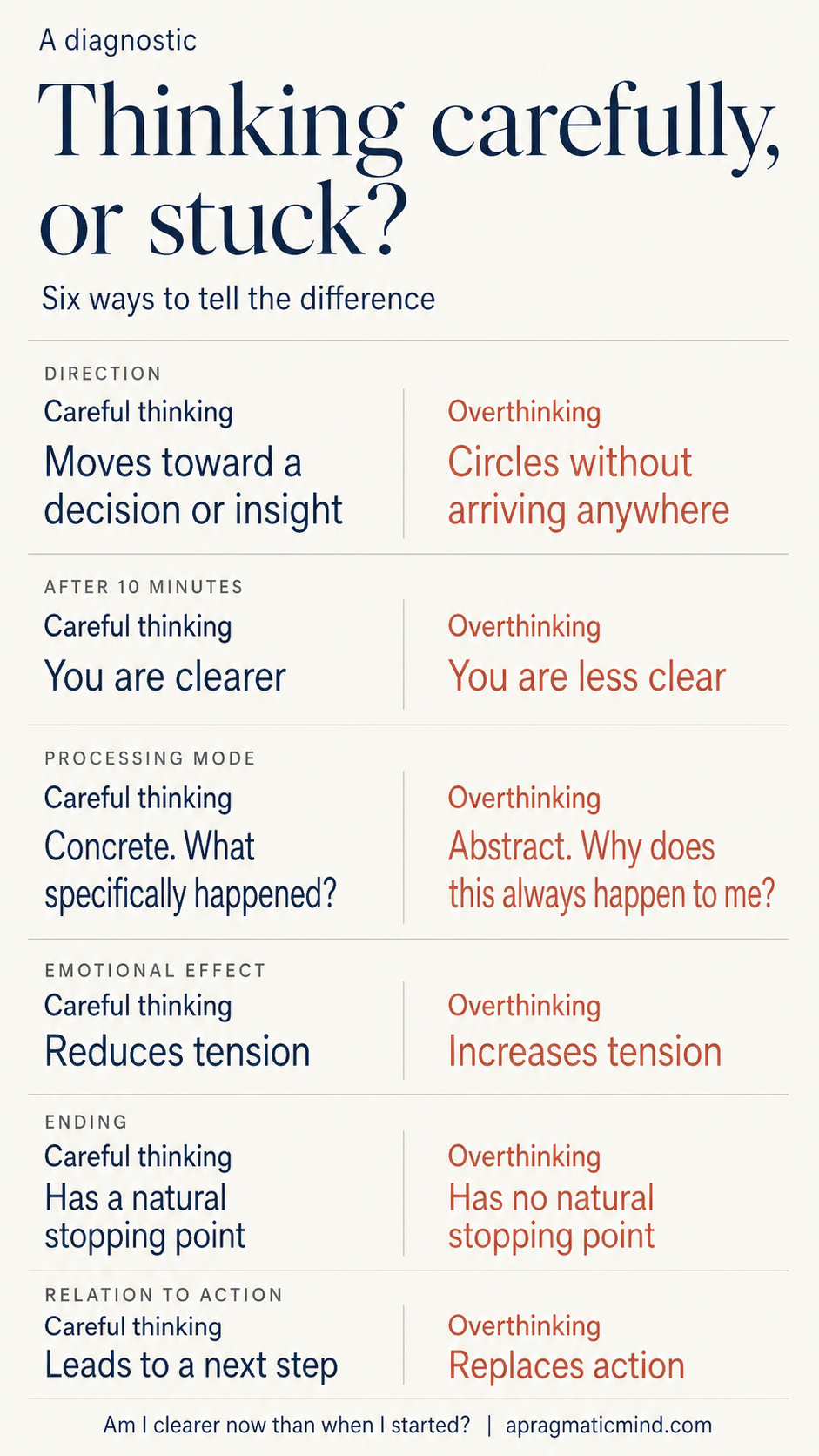
If you are unsure whether you are thinking carefully or overthinking, this comparison can help:
| Careful Thinking | Overthinking | |
|---|---|---|
| Direction | Moves toward a decision or insight | Circles without arriving anywhere |
| After 10 minutes | You are clearer | You are less clear |
| Processing mode | Concrete: "What specifically happened?" | Abstract: "Why does this always happen to me?" |
| Emotional effect | Reduces tension | Increases tension |
| Ending | Has a natural stopping point | Has no natural stopping point |
| Relationship to action | Leads to a next step | Replaces action |
If you recognize yourself more in the right column, you are not broken. You are using a normal brain mechanism in a way that does not serve you. The strategies above can help you shift toward the left.
-
They overlap but are not identical. Perfectionism can drive overthinking: when no result feels good enough, every decision becomes an endless optimization problem. An email that is already well-written gets rewritten six more times because it might not be perfect. But not every overthinker is a perfectionist, and not every perfectionist overthinks. Perfectionism is one possible fuel for the loop, not the loop itself.
When Is Overthinking a Sign of Anxiety or Depression?
Overthinking is not a mental illness. But it can be a symptom of one.
Nolen-Hoeksema's longitudinal research showed that chronic rumination predicts the onset of depressive episodes and is closely linked to Generalized Anxiety Disorder (Nolen-Hoeksema, 2000). That does not mean everyone who overthinks has a clinical condition. Most people who read this article do not. But there are signals worth paying attention to.
If you regularly cannot fall asleep because your thoughts will not stop. If overthinking prevents you from making decisions that affect your life, not just your work. If the pattern is getting worse over time, not better. In those cases, talking to a psychologist or therapist is not a sign of weakness. It is a practical step.
Adrian Wells' Metacognitive Therapy has strong evidence for treating both anxiety and depression in 8 to 12 sessions. It is structured, time-limited, and focused on exactly the mechanisms described in this article.
You do not need to apply all four strategies at once. Start with the one that matches what you recognize most. If you catch yourself replaying conversations after meetings, the concrete processing shift (Strategy 2) is probably the most useful place to begin. If open-ended projects trigger your worst loops, reducing uncertainty (Strategy 3) will give you the quickest relief. If you just want a simple daily check, the 10-minute test works anywhere.
One thing worth noting: the workplace section of this guide exists because I spent years thinking I had a personal overthinking problem before realizing that half of it was structural. Naming that distinction changed more for me than any individual technique.
If you want a hands-on starting point for breaking the abstract thinking loop, reflective journaling is one of the most accessible approaches. For a broader look at how writing can support clearer thinking, the complete guide to journaling covers five methods compared side by side, including Morning Pages, which are specifically designed to clear mental noise before your day begins. And if overthinking shows up most when you need to communicate under pressure, the GRIP method for giving clear answers addresses the uncertainty that often triggers the loop in the first place.
Sources
Danziger, S., Levav, J., & Avnaim-Pesso, L. (2011). Extraneous factors in judicial decisions. Proceedings of the National Academy of Sciences, 108(17), 6889-6892.
Dugas, M. J., Gagnon, F., Ladouceur, R., & Freeston, M. H. (1998). Generalized anxiety disorder: A preliminary test of a conceptual model. Behaviour Research and Therapy, 36(2), 215-226.
Mark, G., Gonzalez, V. M., & Harris, J. (2005). No task left behind? Examining the nature of fragmented work. Proceedings of the SIGCHI Conference on Human Factors in Computing Systems, 321-330.
Nolen-Hoeksema, S. (1991). Responses to depression and their effects on the duration of depressive episodes. Journal of Abnormal Psychology, 100(4), 569-582.
Nolen-Hoeksema, S. (2000). The role of rumination in depressive disorders and mixed anxiety/depressive symptoms. Journal of Abnormal Psychology, 109(3), 504-511.
Nolen-Hoeksema, S. (2003). Women Who Think Too Much: How to Break Free of Overthinking and Reclaim Your Life. Henry Holt and Company.
Nolen-Hoeksema, S., Wisco, B. E., & Lyubomirsky, S. (2008). Rethinking rumination. Perspectives on Psychological Science, 3(5), 400-424.
Treynor, W., Gonzalez, R., & Nolen-Hoeksema, S. (2003). Rumination reconsidered: A psychometric analysis. Cognitive Therapy and Research, 27(3), 247-259.
Van Randenborgh, A., de Jong-Meyer, R., & Hüffmeier, J. (2010). Decision making in depression: Differences in decisional conflict between healthy and depressed individuals. Clinical Psychology and Psychotherapy, 17(4), 285-298.
Watkins, E. R. (2008). Constructive and unconstructive repetitive thought. Psychological Bulletin, 134(2), 163-206.
Wells, A. (2009). Metacognitive Therapy for Anxiety and Depression. Guilford Press.
