How to Give Clear Answers to Broad Questions
Reading time: 14 min
What you will find here:
- Why broad questions cause rambling: your working memory holds three to five items (Cowan, 2001), and a big question activates fifteen directions at once. The problem is not you. It is a lack of structure in the moment.
- The GRIP method: a four-step sequence (Ground, Relate, Illustrate, Project) that turns a ten-minute ramble into a 60-second clear answer. Built from Minto's Pyramid Principle, Cognitive Load Theory, and the Recency Effect.
- Four real examples of GRIP applied to meetings, networking events, presentations, and personal conversations, plus a simple practice routine to make it automatic.
Someone asks you: "What do you think about AI?" Or: "How do you see our department evolving?" Or, at a dinner party: "So what exactly do you do?"
You know a lot about the topic. That is not the problem. The problem is that your brain activates fifteen possible directions at once, and before you have picked one, you are already talking. You start somewhere, jump to the next thought, notice you are drifting, try to course-correct, and end up with an answer that was three times longer than it needed to be and half as clear.
The feeling afterwards is always the same: "That is not what I actually wanted to say."
If this sounds familiar, you are not alone. And you are not bad at communicating. You are running into a well-documented cognitive limitation that affects everyone, especially people who know a lot about the topic they are asked about.
The issue is not a lack of knowledge. It is a lack of structure in the moment. And once you understand why it happens, there is a surprisingly simple way to fix it. If you are curious why I write about overthinking the way I do, this is the starting point.
Why You Ramble When Someone Asks a Big Question
When someone asks you a specific question, like "When is the deadline?" or "Which tool do you use for project management?", the question itself provides the structure. There is one answer, or maybe two. Your brain knows exactly where to go.
Broad questions do the opposite. They give you no anchor point at all. "What do you think about remote work?" could lead to a discussion about productivity, culture, management styles, tools, personal preferences, company policy, or hybrid models. All of these are valid. None of them is the obvious starting point. And that is exactly where things go wrong.
Your working memory has hard limits. In 1956, psychologist George Miller published one of the most cited papers in cognitive science, showing that our short-term memory can hold roughly seven chunks of information at once. In 2001, Nelson Cowan refined this further: when you strip away rehearsal strategies and memory tricks, the real limit is closer to three to five chunks. That is all your brain can actively juggle at the same time.
When a broad question hits you, your mind does not generate three possible answers. It generates ten or fifteen. That immediately exceeds your working memory capacity. You cannot hold all of them, so you start talking before you have decided which direction to take, hoping it will come together as you go. It usually does not.
Too many options lead to worse decisions, not better ones. This is the same mechanism behind what researchers call choice overload. Alvin Toffler coined the term "overchoice" in 1970, and Sheena Iyengar and Mark Lepper demonstrated it experimentally in 2000: when people face too many equally attractive options, they either make worse choices or avoid deciding altogether. A broad question is essentially a shelf full of equally valid answers. Without a way to narrow down quickly, you freeze or you ramble.
Your cognitive load triples. John Sweller's Cognitive Load Theory, developed in 1988, distinguishes three types of mental burden: intrinsic load (the difficulty of the topic itself), extraneous load (how the information is presented or structured), and germane load (the effort of building a coherent mental model). With a broad question, all three spike simultaneously. The topic is complex, there is no structure given to you, and you have to build a coherent answer from scratch while speaking. That is a recipe for cognitive overload.
So here is the reassuring part: your brain does not ramble because you lack intelligence or communication skills. It rambles because broad questions create a perfect storm of cognitive overload: too many options, no anchor point, no pre-built structure. The fix is not thinking harder. It is bringing a structure with you that you can activate in the moment.
If you are interested in the psychology behind why we get stuck in situations like these, The Psychology of Procrastination explores a closely related mechanism: too many options plus too little clarity equals paralysis. If unclear communication triggers overthinking loops, the guide to overthinking explains the psychology behind it.
-
Broad questions activate too many possible response paths simultaneously. Research on working memory by Nelson Cowan (2001) shows that our brains can only hold three to five chunks of information at once. Without a pre-built structure, you try to cover everything, and the result is rambling. The problem is not a lack of knowledge but a lack of structure in the moment.
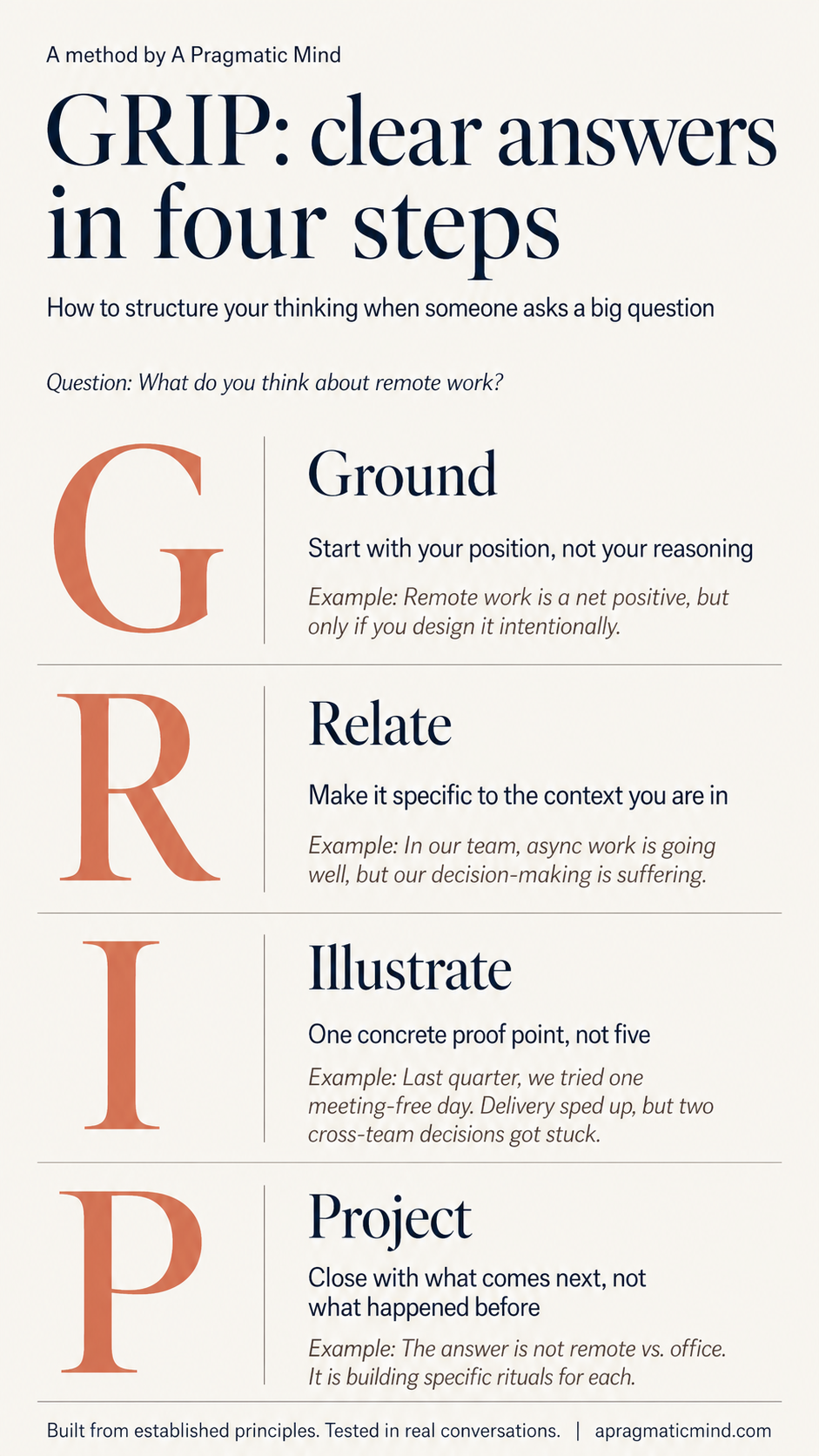
The GRIP Method: How to Organize Your Thoughts in Seconds
I want to be upfront about something: GRIP is not an academic framework. You will not find it in a textbook or a peer-reviewed paper. I built it myself because I kept running into the exact problem I just described, and none of the existing models solved it the way I needed.
The individual building blocks are well-researched. Barbara Minto's Pyramid Principle for leading with the conclusion. Cognitive Load Theory for understanding why structure reduces mental strain. The STAR method for using concrete examples. The Recency Effect for closing with impact. But the combination of these into a four-step sequence that works in real time, that is something I assembled through trial and error.
In the spirit of Tiny Experiments: I took established principles, adapted them to my specific problem, tested what worked, and kept what stuck. GRIP is the result.
It stands for:
G - Ground: Start with your position
R - Relate: Make it specific for the context
I - Illustrate: One proof point, not five
P - Project: Close with what comes next
Ground: Start With Your Position, Not Your Reasoning
Say in one sentence where you stand. Not the whole answer. Not the nuance. Just your core position in a single, clear statement.
This sounds simple, but it is the opposite of how most people naturally communicate. We tend to think bottom-up: we gather facts, consider perspectives, weigh arguments, and arrive at a conclusion. When we speak, we follow the same path. We give the listener our entire thought process, and the conclusion comes at the end, if it comes at all.
Barbara Minto, a former McKinsey consultant, observed this pattern and developed what she called the Pyramid Principle: effective communication works top-down, not bottom-up. You state your conclusion first, then support it. Senior executives, she noticed, want to know where you stand before they hear how you got there. The same is true in everyday conversations. People can follow your reasoning much better when they already know your destination.
There is also a cognitive reason why Ground works. Remember the choice overload problem? When you commit to a position in the first ten seconds, you immediately reduce the number of open response paths from fifteen to one. Your brain can let go of the other fourteen and focus on supporting the direction you have chosen. That single act of commitment clears the cognitive fog.
Example:
Question: "What do you think about remote work?"
With Ground: "I think remote work is a net positive, but only if you design it intentionally."
Without Ground: "Well, remote work is interesting... I mean, there are studies that say... and at my last company we did it differently... also it depends on the role..."
The first version gives both you and your listener a clear anchor. The second version is what happens when you try to find your position while already speaking.
Relate: Make Your Answer Relevant to the Situation
Now that you have stated your position, make it concrete. Connect it to the context you are in: the team, the company, the project, the person you are talking to.
This is essentially the "So what?" principle. Any abstract statement, no matter how smart, loses its impact if the listener has to figure out the relevance themselves. When you do the connecting for them, you reduce what Sweller would call the extraneous cognitive load: you are removing the unnecessary mental work your listener would otherwise have to do.
Relate also helps you. Miller's concept of "chunking" shows that we process information more easily when it is organized into meaningful units. By grounding your abstract position in a specific, familiar context, you turn a vague idea into something concrete that both you and your listener can work with.
Example:
Relate: "In our team, for example, the async work is going well, but we are losing something in how we make decisions together. The quick hallway conversations that used to resolve things in five minutes now take three Slack threads and a meeting."
Notice how this takes the abstract position ("remote work is a net positive if designed intentionally") and immediately makes it tangible. Your listener is no longer processing a general opinion. They are thinking about a specific situation they probably recognize.
Illustrate: Why One Example Beats a Long Explanation
Give one concrete example from your experience. Not a list. Not three examples. One short, specific proof point.
There is a strong cognitive reason for limiting yourself to one example. Research on the Concreteness Effect, formalized by Allan Paivio in his Dual Coding Theory (1986), shows that concrete information is remembered significantly better than abstract statements. When you say "we tried X and Y happened," your listener's brain codes that both verbally and visually. It sticks. When you say "there are various approaches to consider," it evaporates immediately.
And remember Cowan's capacity limit of three to five chunks: if you give your listener three examples, you are using up almost their entire working memory on your proof points alone. One strong example is more persuasive and more memorable than three average ones.
Example:
Illustrate: "When we experimented with one meeting-free day per week last quarter, our project delivery speed went up, but two cross-team decisions got stuck for a week because nobody had the informal touchpoint to resolve them quickly."
Rule of thumb: if your illustration takes longer than 30 seconds, you are including too much detail. Cut to the core.
Project: End With What Comes Next, Not What Happened Before
Close your answer by looking forward. What does this mean for the future? What would be a logical next step? What would you recommend?
Most people end their answers with the last thing they remember saying, which is usually a detail from their example. That is a missed opportunity. The Recency Effect, demonstrated by Bennet Murdock in 1962, shows that people disproportionately remember the last piece of information they hear. If you end with a backward-looking example, the past is what stays in your listener's mind. If you end with a forward-looking recommendation, you are remembered as someone who thinks ahead.
Project also gives your answer closure. Without it, your response feels like an open loop. The listener is left wondering: "So... what is the conclusion?" With Project, your answer is a complete thought with a beginning, a middle, and an end.
Example:
Project: "I think the answer is not 'remote vs. office' but building specific rituals for each. We should probably audit which of our current meeting formats actually need face time and which would work better async."
Notice how the full GRIP sequence creates a coherent, 60-second answer out of a question that could have led to a 10-minute ramble.
-
GRIP stands for Ground (state your position), Relate (make it specific to the situation), Illustrate (one concrete example), and Project (bridge to the future). It combines principles from Barbara Minto's Pyramid Principle, Cognitive Load Theory, and the STAR method into a simple sequence you can use in real time during meetings, presentations, or everyday conversations.
GRIP in Practice: Clear Answers in Meetings, Presentations, and Conversations
Theory is useful. Examples are better. Here are four everyday situations with the full GRIP sequence applied.
When Your Boss Asks a Big-Picture Question
Your manager asks: "How do you see our department evolving over the next year?"
G: "I think we need to get more proactive instead of reactive. Right now, we are spending most of our energy responding to requests."
R: "Specifically, about 70% of our team's time goes into ad-hoc tasks from other departments. That leaves almost no capacity for the strategic projects we keep pushing to next quarter."
I: "Last month, we tracked our time for two weeks, and the data confirmed it. Three people spent over half their time on tasks that were not in our original plan."
P: "If we create a simple intake process and protect two days per week for strategic work, I think we can shift that ratio significantly by Q3."
If you are looking for methods that help with exactly this kind of prioritization, Best Productivity Methods compares several systems designed to separate reactive from proactive work.
-
Pause for a few seconds before you speak. That feels uncomfortable, but it is barely noticeable to others. Use that pause to decide on one single point you want to make, not three. Say that point first, then add context if needed. Most overthinking in meetings happens because you try to build the perfect answer in your head before opening your mouth. Instead, start with an imperfect but clear position and refine it as you talk. Research on choice overload (Iyengar & Lepper, 2000) confirms that fewer options reduce mental strain. The same applies to your own answers: pick one direction, commit, and trust that you can adjust if the conversation requires it.
When Someone at a Networking Event Asks What You Do
Someone asks: "So, what do you do?"
G: "I help companies figure out how to get found online, not through ads, but through the way people actually search for things."
R: "Most of my clients are mid-size B2B companies where the sales cycle starts with someone googling a problem, not a brand name."
I: "One of my recent projects: we rebuilt how a client showed up in Google results for their top 50 search queries, and within six months, their inbound leads doubled."
P: "Right now I am especially interested in how AI search is changing this. When someone asks ChatGPT instead of Google, the rules are completely different."
When You Get an Unexpected Question After a Presentation
You just presented. Someone asks: "How does this compare to what our competitors are doing?"
G: "Honestly, I think we are ahead in execution but behind in one specific area."
R: "Our implementation speed is faster than most competitors I have seen. But where we are lagging is in how we use data to personalize the experience afterwards."
I: "I looked at a competitor's approach last quarter. They are using real-time behavioral data to adjust their messaging, something we do not do yet."
P: "That is actually something I would want to explore as a next step. We have the data. We just have not built the workflow to use it."
When a Friend Asks for Your Opinion on a Life Decision
A friend asks: "Should I quit my job?"
G: "I do not think the question is 'quit or stay.' I think it is 'what specifically is making you unhappy.'"
R: "Because if it is the role itself, then yes, maybe. But if it is your manager or the current project, those things might change without you having to start over somewhere else."
I: "I was in a similar spot two years ago. I was ready to quit, but when I actually listed what bothered me, it was two specific things. I fixed one, and the other resolved itself within three months."
P: "Maybe try writing down the three things that frustrate you most and then honestly ask yourself: would these exist at a new job too?"
Asking yourself structured questions like these is, at its core, a form of journaling. What Is Journaling? explains how writing works as a thinking tool. And if you want ready-made questions to get started, 50 Journaling Prompts has you covered.
-
Yes. Clear thinking under pressure is a skill, not a talent. Start by practicing in writing: take a broad question and draft your answer in four sentences following the GRIP structure. Over time, the structure becomes automatic and you can apply it in real-time conversations. Journaling and regular self-reflection accelerate this process.
How to Practice Structuring Your Thoughts (Without Overthinking It)
GRIP only works if you do not try it for the first time in the moment that matters. Like any thinking structure, it needs practice before it becomes automatic.
Start with writing, not speaking. Before you try GRIP in a live conversation, write it down. Pick a broad question ("What do you think about X?") and draft your GRIP answer in four sentences, one per step. This trains the structure without the time pressure of speaking. Writing is how you learn to think clearly. It is the core principle behind Morning Pages and behind journaling in general.
The 10-second rule. Give yourself 10 seconds before answering any broad question. Not to plan your full response, but to formulate your Ground sentence. Once you know where you stand, the rest follows. Those 10 seconds feel long to you but are barely noticeable to your listener.
Review after conversations. After a meeting or an important conversation, briefly reflect: Could I have structured my answers more clearly? Where did I drift? Where would an example have helped? This is metacognition applied to communication: thinking about how you think and speak.
The three-sentence challenge. For one week, try answering every broad question in a maximum of three sentences before you elaborate further. This forces prioritization. Treat it as a small experiment, not a permanent rule. Tiny Experiments describes exactly this approach: test a method without committing to it long-term. If it works, keep it. If not, adjust.
-
Use a four-step structure: state your position first (Ground), make it specific for the context (Relate), add one concrete example (Illustrate), and close with a forward-looking statement (Project). The key is to commit to a direction within the first 10 seconds instead of trying to cover everything at once.
When You Do Not Need a Framework (And What to Do Instead)
GRIP is for a specific type of situation. It is not a universal communication tool.
Specific questions do not need GRIP. If someone asks "When is the deadline?", just answer. A framework would be overkill.
Emotional conversations need listening, not structure. If a friend is venting about a difficult day, they do not need your four-step method. They need you to listen.
Brainstorming sessions need divergence, not convergence. In creative contexts, the goal is to generate as many ideas as possible. GRIP is for convergent communication, where you need to narrow down and be clear. Brainstorming requires the opposite.
When you genuinely do not know. GRIP helps you structure knowledge you already have. If you truly have no informed opinion on a topic, the clearest answer is: "I do not know enough about this to have a useful perspective." That is not a weakness. That is intellectual honesty.
If you find that the real issue is not structure but a tendency to overthink everything, The Psychology of Procrastination goes deeper into the cognitive mechanisms that keep us stuck.
Sources:
Miller, G.A. (1956). The Magical Number Seven, Plus or Minus Two: Some Limits on Our Capacity for Processing Information. Psychological Review, 63, 81-97.
Cowan, N. (2001). The Magical Number 4 in Short-Term Memory: A Reconsideration of Mental Storage Capacity. Behavioral and Brain Sciences, 24(1), 87-114.
Sweller, J. (1988). Cognitive Load During Problem Solving: Effects on Learning. Cognitive Science, 12(2), 257-285.
Toffler, A. (1970). Future Shock. Random House.
Iyengar, S.S. & Lepper, M.R. (2000). When Choice Is Demotivating: Can One Desire Too Much of a Good Thing? Journal of Personality and Social Psychology, 79(6), 995-1006.
Minto, B. (2009). The Pyramid Principle: Logic in Writing and Thinking. Pearson Education.
Paivio, A. (1986). Mental Representations: A Dual Coding Approach. Oxford University Press.
Murdock, B.B. (1962). The Serial Position Effect of Free Recall. Journal of Experimental Psychology, 64(5), 482-488.
